Story · Spooky · Ages 8-12
The Whistling Jar on Pepper Lane
When a strange jar starts whistling from the back of the pantry, eleven-year-old Tessa must figure out what it wants before the sound draws every lost thing in town to her kitchen door.
Reading settings — text size, spacing, theme and read-aloud mode

Tessa found the jar on the bottom shelf of the pantry, behind the rice and the sleepy bag of flour. It was clay, brown as a robin’s egg, with a lid pressed tight and a small chip missing from the rim.
She lifted it down. It was lighter than it looked, and cold, the way a stone is cold in the shade.
Then it whistled.
A thin note came out of it, low and sad, like a kettle three rooms away. Tessa turned it over. No hole, no crack, nothing but the chip.
“Mum?” she called. “This jar is whistling.”
Her mother came in with a dish towel over one shoulder. “Whistling?”
“Listen.” Tessa held it up.
Her mother tipped her head. “I don’t hear anything.”
“It’s right there,” Tessa said. “Like a bird with a cold.”
Her mother took the jar and shook it gently. It was quiet in her hands, Tessa could tell. “It came with the house,” she said. “The old lady before us left a few things in the pantry. I thought it was only this jar.”
“Can I keep it?”
“It’s a jar,” her mother said. “Jars are for keeping.”
That night Tessa put the jar on her windowsill, where the moon could see it. The whistle went on and on, thin and patient, like someone calling a name across a field.
***
The whistle grew louder after dark. By bedtime it was almost a song, and Tessa lay with her blanket over one ear.
In the morning there was a button on the doorstep. Small, white, four holes. Nobody in the house had lost a button.
The next morning brought a hairpin. The morning after that, a brass key with no lock to fit.
Tessa gathered them in her palm at breakfast. “These keep showing up,” she said. “On the step. Right outside.”
Her mother buttered toast. “The wind brings things.”
“The wind doesn’t bring keys.”
“Then a neighbor,” her mother said, but she looked at the key a little too long.
That night the whistle was louder still. It pulled at Tessa’s ears like a hand. She took the jar off the sill and wrapped it in a gym shirt.
“Sorry,” she whispered, and pushed it deep into the closet, behind her boots.
The whistle went quiet. Tessa breathed out and got into bed.
Then a small tap sounded at the door. She lay still. Another tap, and a soft scrape, like something being set down carefully.
Morning came gray. On the doorstep sat a thimble, a marble, and a silver spoon with a bent handle.
Her mother stood over them with her hands on her hips. “Tessa,” she said slowly. “Where is that jar?”
“In my closet,” Tessa said, and her voice came out smaller than she meant it to.
Her mother opened the closet and lifted the jar out of the boot. “It’s just a jar,” she said, turning it in her hands. “Old clay. Probably older than the house.”
“It whistles,” Tessa said. “Only me.”
Her mother held it to her ear and shook her head. “I hear the fridge.” She set the jar on the kitchen counter and went to make tea.
All afternoon the jar sat there. Tessa did her homework at the table so she could keep an eye on it. It did not whistle. It looked like any jar, brown and lumpy, with a chipped rim and a lid that did not quite match.
Then, at dusk, it began.
Soft at first, a thin thread of sound. Tessa put down her pencil. The tune climbed up and down, five notes and a pause, then five notes again. It was slow and a little crooked, like a song somebody half remembered.
Tessa’s whole body went still. She knew that tune.
Every Sunday her grandmother had hummed it while she peeled apples, standing at this same counter with her sleeves rolled. She had never known its name. She had never heard anyone else hum it.
“Mum,” Tessa said. “Come here. Quick.”
Her mother came, wiping her hands. “What is it?”
“Listen.” Tessa pointed at the jar. “That’s Gran’s song. The apple one.”
Her mother listened, head tilted. Her face did something complicated. “I don’t hear a thing, love.”
“It’s calling,” Tessa said. The words came out before she had thought them, and she knew they were true. “It’s not singing for me. It’s calling to something.”
Her mother looked at the jar for a long moment. Then she said, quietly, “Gran had a lot of old things in the attic.”
***
That night Tessa lay awake until the house went dark and still. The whistle came again at midnight, clear as a finger on a glass rim. It was not sad now. It was insistent. It wanted her to follow.
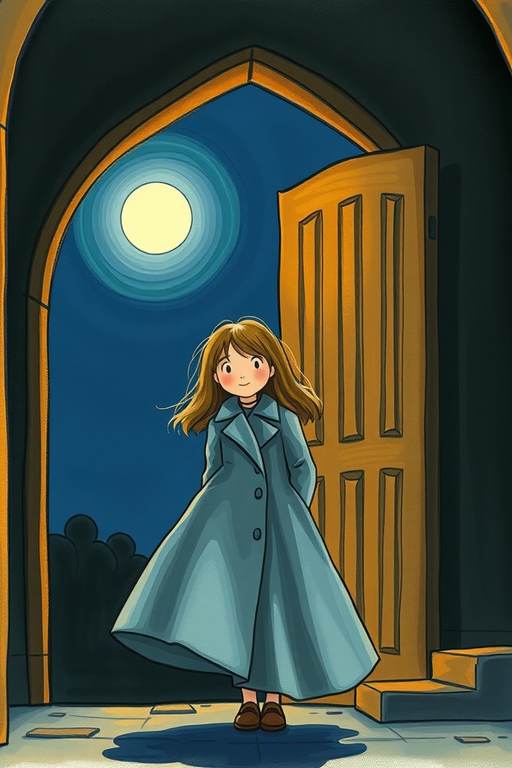
She got up. The hallway was cold under her bare feet, and the floorboards creaked one by one like they were telling on her. She carried the jar against her chest. It hummed through the clay into her elbows.
The attic door was at the end of the landing, behind a little hook latch. Tessa had never opened it. The string on the light was short and stiff. She pulled, and a bare bulb blinked on above the rafters.
Boxes leaned against the chimney. Dust sat on everything like gray snow. The whistle had grown very loud now, and Tessa followed it past the boxes, past a rolled-up rug, to a corner where a tea chest sat under an old coat.
She knelt and lifted the lid. Inside was her grandmother’s handwriting on a folded card, and under it a scarf that smelled of lavender, and a photograph of a young woman laughing at a kitchen table. And tucked in the corner, wrapped in a tea towel, was another jar.
The same clay. The same chipped rim. It shook in time with the one in Tessa’s arms.
“You’re a pair,” Tessa whispered. The two jars whistled back at her, one high, one low, and the sound climbed up into the rafters together and would not stop.
Tessa set her jar down on the tea chest beside the other one. The two of them wobbled on their bases, knocking softly against the wood, and the whistling rose until it filled the whole attic. It was a high thin sound and a low warm sound, braided together like two hands clasped.
Then, all at once, it stopped.
The silence was so sudden that Tessa heard her own breathing, and the tick of the house settling, and a car passing somewhere far off on the road. She waited. Nothing whistled. The jars sat still and quiet, side by side, as if they had been there for fifty years and never made a sound at all.
“You found each other,” Tessa said. Her voice sounded too loud in the dust.
She sat back on her heels and looked at the two jars. One was hers now, the one that had called her down the hallway and filled her room with lost buttons. The other was her grandmother’s, wrapped in a tea towel and left here in the dark.
She picked up her jar. It was cool and heavy and quiet. For a moment she thought about carrying it back down the stairs, setting it on her shelf, keeping it. It had chosen her, after all. It had whistled only to her.
“But you weren’t calling to me,” she said slowly. “Not really.”
The jar did not answer. The photograph on the tea chest looked up at her, the young woman laughing at the kitchen table. Tessa thought of her grandmother’s visits, the tunes she hummed while she peeled apples, the way she always knew where a lost thing had rolled.
“You were calling to each other,” Tessa said. “You were both lonely.”
Her hands were shaking a little. She took a breath, the way you do at the top of a high slide. Then she set her jar down beside the other one and folded the tea towel around them both.
***
Tessa lifted the two jars, wrapped together, back into the tea chest. She set them in the corner, jar against jar, and put the folded card on top. Then she closed the lid and brushed the dust from her hands.
“There,” she said. “Now you can talk all night if you like.”
The bare bulb swung gently above her. Down below, the house felt different already. The stairs did not creak the way they had on the way up. The dark in the hallway was only dark, not listening.
At the attic door, Tessa stopped. Something small was on the floor by the latch, where the light fell from the bulb. She bent and picked it up. It was a little clay whistle, no bigger than her thumb, shaped like a bird. Her grandmother’s card had said something about it, she remembered. A whistle for the pocket, for the walks home.
Tessa turned it over. A thin note came out of it when she blew, small and clear and her own.
She put it in her pocket and pulled the light string. The attic went dark behind her, but it was a friendly dark now, the dark of a room where two old friends were sitting together.
In her bed, later, Tessa lay with the whistle under her pillow. No sound came from above. The house was quiet and right, and the quiet was full instead of empty, like a house where everyone is home.
She fell asleep holding it. In the morning she would keep it in her pocket, and sometimes on the walk to school she would blow one small note, just to hear it answer back.
Written with an AI writing tool and checked automatically before publishing. How we make stories.
 Read next