Story · Quest · Ages 8-12
The Girl Who Bottled the Dark
When the moon vanishes from the night sky, a girl with a jar of captured darkness sets out across the hills to bring it home, learning that courage sometimes means letting go of what you carry.
Reading settings — text size, spacing, theme and read-aloud mode

Mira was on the back step with her jar when the moon went out.
One moment it hung over the hill like a lantern on a hook. The next, the sky was a black bowl with no light in it. Not a cloud. Clouds have edges. This had none.
“Gran,” Mira whispered.
She heard her grandmother’s stick tap across the kitchen floor. Gran came out and stood beside her, and neither of them said anything for a while.
“Look,” Gran said at last, and pointed.
A thin grey wisp curled down through the dark like smoke from a candle just blown out. Mira held up her jar, the one she used for catching fireflies. The wisp slipped inside. She screwed the lid tight, and the jar grew cold in her hands, and something in it moved, soft as a moth.
“That’s a piece of tonight,” Gran said. “Keep it safe.”
“What happened to the moon?”
“Come in and I’ll tell you.”
They sat by the stove. Gran’s hands were warm and wrinkled, and she held them out to the fire.
“Long ago,” she said, “the moon was pulled across the sky by a thread. One end is tied to the moon. The other end the Moon Keeper spins, up past the hills, and the spinning pulls her along.”
“Like a kite,” Mira said.
“Exactly like a kite. But a keeper can get tired. And when she does, the thread goes slack, and the moon drops out of sight.”
Mira looked at the jar. Inside, the dark moved.
“It won’t fix itself,” Gran said quietly. “Someone has to carry that up the hill and give it back.”
“Me?”
“You’re the one who caught it.” Gran smiled. “Sleep first. You can’t walk in the dark without a little of it in you.”
***
At dawn, Mira set out with the jar under her arm.
A thin silver thread lay across the grass, just visible in the grey light. She had never seen anything like it. It was faint and fine, like a spider’s line, and it ran up the hill and over the top and away.
“Follow it,” Gran had said. “It will take you where you need to go.”
So she followed. The path went up between the gorse bushes, and the thread went with it, and the jar bumped warm and cold against her side.
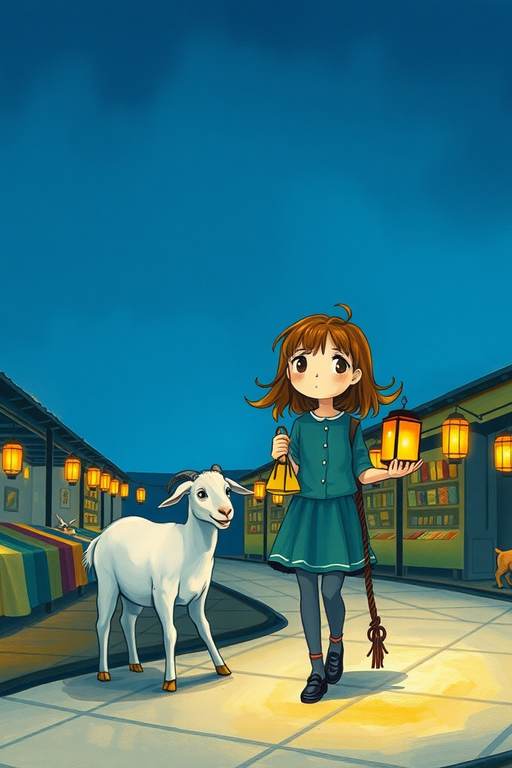
At the top of the first hill, a goat was standing in the middle of the path.
He was white with grey patches, and one horn was crooked, and he looked at Mira as though she had come to take something from him.
“Good morning,” Mira said.
“Is it?” said the goat.
Mira stopped. “You can talk.”
“So can you. We’re even.” He shuffled his hooves. “Where are you going, in the dark?”
“The moon’s gone. I’m taking it back.”
The goat looked at the jar. Then he looked at the sky, where there was nothing.
“I don’t like the dark,” he said, very quietly. “I’ve been standing here all night because I couldn’t see to go anywhere.”
“You could come with me,” Mira said. “I can see the path.”
The goat thought about it. He shifted from foot to foot. Then he nodded, once, the way a goat does when it has decided something important.
“I’m called Fen,” he said.
“Mira.”
They went on together, up the slope, following the silver thread. Fen walked close beside her, and his small hooves clicked on the stones, and the morning opened up ahead of them like a door.
By mid-morning they came to the ford, where the river ran shallow and quick over a bed of round grey stones. The silver thread lay across the water like a fishing line. Mira stepped in first, and the cold came up through her boots and made her gasp.
“Hold the jar high,” said Fen from the bank. “That’s what I’d do.”
“You can’t hold anything,” Mira said.
“I can advise.” He put one hoof in the water and pulled it out again.
Mira waded deeper, lifting the jar over her head. The current pushed at her knees. Halfway across, a stone rolled under her foot, and she threw out her hand to catch herself. The jar struck the water with a flat sound, and the lid came loose, and the darkness poured out.
It spread across the river like ink, then thinned, then was gone. Mira stood in the shallows holding an empty jar. Her hands were shaking.
“It’s all right,” said Fen, though his voice wobbled.
“It isn’t. That was the only dark I had. The Keeper needs it. I heard her say so, in the old story.” She looked back at the bank they had left. “I could go home. Grandmother would say I tried.”
Fen climbed onto a stone beside her. “You could. But I don’t like the dark, Mira. I’d still have to stand somewhere all night.”
Mira looked at the thread, still bright, still pointing on. She screwed the lid back on the empty jar. “Then we keep going. Empty jar and all.”
***
The hill on the far side of the ford was steeper than it looked. Mira climbed with the jar under her arm, and Fen scrambled behind her, muttering about goats and hills and sensible animals who stayed at the bottom.
“You can turn back,” Mira said over her shoulder.
“I know I can,” said Fen. “I’m choosing not to. There’s a difference.”
The thread led up through heather and loose slate, and near the top it ran under a low door set into the hillside. The door was round and old, and the handle was worn smooth.
Mira knocked. Nothing. She knocked again, and the door swung in.
Inside, the cottage was one room, warm and close. An old woman sat at a spinning wheel, and her hands were on the wheel, and the wheel was not turning. Her hair was white as the moon, and her face was tired past tired.
“Keeper?” Mira said.
“I’m the Keeper.” The old woman didn’t look up. “And the wheel won’t turn, and the thread won’t spin, and the moon sits in the dark like a stone at the bottom of a well.”
“I brought you darkness,” Mira said. “But I spilled it at the ford.”
At that, the Keeper did look up. “You spilled it,” she said, “and you came anyway.”
The Keeper pushed her chair back and stood, slowly, one hand on the wheel. “Every night,” she said, “I spin the thread that pulls the moon across the sky. Not a long thread. Just long enough to get it from one side to the other.” She held up a hand, and it shook. “But my hands are tired, and the wheel needs dark to grip, and the dark all ran out.”
Mira set her jar on the table. The glass was empty and clean. “I have a little left,” she said. “A wisp. It’s all I caught.”
“A wisp won’t do it,” said the Keeper. “It takes a whole night’s worth.”
Fen the goat stepped forward. “She carried it up a hill and dropped it in a river,” he said. “She’s not going to be talked out of it now.”
The Keeper looked at Mira for a long moment. Then she lifted the lid on the side of the spinning wheel. Inside was a hollow the size of a walnut, and it was grey and dry as dust.
“Put it here,” she said.
Mira uncorked the jar and tipped it. Nothing came out at first. Then a thin curl of dark slid down the glass, like smoke going the wrong way, and dropped into the hollow. It was very little. Mira’s chest went tight. She had held that dark for three nights, and now it was gone.
The Keeper pressed the lid down and set her foot on the treadle. The wheel groaned. Then it turned. The thread came out of the spindle thin as a hair and silver as a fish, and where the dark touched it, it began to glow.
“Oh,” said Mira.
“Hold the end,” said the Keeper. “Gently. Don’t pull.”
***
Mira held the thread. It was warm and light, and it hummed a little, like a bee in a jar. The Keeper spun, and the thread went out through the door and up into the sky, and somewhere far above, something moved.
“Go out and watch,” said the Keeper. “Both of you. I’ll keep spinning.”
Outside, the hillside was dark and cold and smelled of wet slate. Fen stood close against Mira’s leg. Above them the sky was black and empty, and the stars looked small and shy, as if they’d been left on their own too long.
Then the edge of the hill went pale.
A thin curve of white came up over the ridge, slow as a bubble rising in water. It grew. It was the moon, whole and round and bright, and the dark hills turned silver and blue, and Fen made a small surprised sound in his throat.
“It’s up,” Mira whispered. “It’s actually up.”
The Keeper came to the door and leaned on the frame. Her face was still tired, but she was smiling. “Every night,” she said, “someone has to hold the end. Tonight it was you.”
Mira looked at her empty jar. “It’s not empty,” she said. “It just doesn’t have dark in it anymore.”
“No,” said the Keeper. “It doesn’t. Now go home before your grandmother worries.”
They walked down the hill in the moonlight, Fen’s hooves clicking on the stones. The thread of moonlight lay across the path all the way, and Mira followed it, and she was not afraid of the dark at all.
At the ford, Fen stopped. “Same way back?” he said.
“Same way back,” said Mira. “Come on. I know the way now.”
And the moon followed them home.
Written with an AI writing tool and checked automatically before publishing. How we make stories.
 Read next