Story · Spooky · Ages 8-12
Marisol and the Midnight Bell
When Marisol moves to a village where the old church bell rings by itself at midnight, she sets out to discover who is pulling the rope. What she finds is not a ghost at all, but something that needs a friend.
Reading settings — text size, spacing, theme and read-aloud mode

Marisol had moved three times in four years, so she knew how to read a new house. She read the squeaky third stair and the window that stuck. She read the kitchen drawer that smelled like cinnamon. But the village outside was harder.
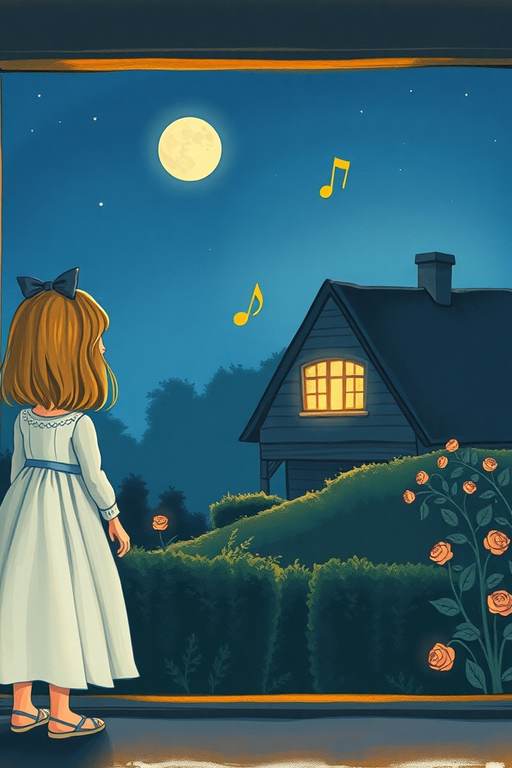
On her first night, she lay in a bed still crowded with unpacked boxes. The window was open a crack. A breeze pushed the curtain in and out, slow as breathing.
Then the bell rang.
One low note, not loud, but it went through the walls like a spoon through soup. Marisol sat up straight.
At breakfast, she asked her mother about it.
“The church bell?” Her mother poured milk. “That old thing hasn’t rung in years. The rope’s broke. Everyone knows that.”
“It rang last night. At midnight.”
Her mother smiled the way adults do when they think you dreamed something. “Maybe a fox bumped it. Eat your eggs.”
Marisol ate her eggs and thought about the note. It hadn’t sounded like a bump. It sounded like a pull.
That day she walked to the church. It sat at the edge of the village, small and gray, with a tower like a raised finger. The graveyard behind it was tidy and green. Nothing looked haunted. Nothing looked like it could make a sound at midnight.
An old man was trimming the hedge by the gate.
“Excuse me,” Marisol said. “Does the bell work?”
He stopped clipping. “Bell’s been silent since before you were born, little one. Why?”
“I heard it. Last night.”
He looked at the tower for a long moment. “Wind gets in there sometimes,” he said, but his voice had gone quiet. “Wind can fool you.”
Marisol didn’t think the wind could fool her. She had heard a bell, and bells didn’t ring themselves.
***
The next morning, Marisol went back to the church. The front door was unlocked, so she slipped inside. It smelled like old wood and candle wax. Dust floated in the light from the high windows.
At the back, behind a curtain, she found the tower stairs.
They were narrow and wooden, and each step groaned under her sneakers. Up and up she went, past a window with a cracked pane, past a ledge where a pigeon had made a nest of twigs.
The bell room was at the top. It was small and round, with a huge bronze bell hanging in the middle. The bell was green with age. A rope hung down from it, ending in a knot.
Marisol touched the rope.
It was warm.
She pulled her hand back. Then she touched it again. The rope was frayed near the top, the threads rubbed thin, as if someone had been pulling and pulling. The warmth was not sun-warm. It was like a hand had just let go.
“Hello?” she said.
Her voice bounced off the bell and came back small. Nobody answered.
She looked around the floor. There were no footprints in the dust except hers. But near the wall, where the rope hung, the dust was brushed clean in a curve. Like someone had stood there a long time.
Outside, the wind pushed at the tower. The bell swayed a tiny bit, and the rope moved with it. But it didn’t ring.
Marisol stood very still and listened. Somewhere below, the old man’s shears went snip, snip against the hedge. A dog barked twice. The village was ordinary.
But the rope was warm in her hand, and the dust knew someone had been there.
“I’ll come back,” Marisol whispered. She didn’t know why she said it. It just felt like a promise.
She climbed down the stairs, and the church felt emptier than before.
That night Marisol couldn’t sleep. The moon was full, so she pulled on her coat and slipped out the back door. The churchyard was silver and still. She hid behind the old yew tree where she could see the tower window.
The bell rang at midnight. One low note, then quiet. Marisol held her breath. In the window, something pale moved. It was the shape of a person, small and thin.
“Hello?” Marisol called. Her voice came out louder than she meant.
The shape slid away from the glass. Marisol waited, but nothing else happened. She ran home and lay awake until morning.
At breakfast her mother asked, “You look tired. Bad dreams?”
“Just couldn’t sleep,” Marisol said. She didn’t mention the shape. She wasn’t sure she had seen it.
***
After school, Marisol found Tomas by the low stone wall. He was stacking pebbles into a tower.
“Do you believe in ghosts?” she asked.
Tomas didn’t laugh. “My grandmother says the bell rings when someone is lost,” he said.
“What does that mean?”
“She never told me. She just said the bell has a job.”
Marisol looked at the church tower. “I think someone is up there.”
Tomas dropped his pebbles. “Who?”
“I don’t know. But I heard the bell, and I saw something in the window.”
Tomas was quiet. Then he said, “I’ll come with you.”
They waited until the old man with the shears went home for tea. Then they slipped through the church door. The stairs were narrow and dark. Marisol went first, and Tomas held the back of her coat.
At the top, the bell hung huge and black. The rope swayed, just a little. Marisol stepped around the bell, and there, pressed into the corner, was a girl. She was small, maybe six, with hair like cobwebs and a dress the colour of old paper.
“Don’t ring it again,” the girl whispered. “I’m sorry. I didn’t mean to scare you.”
Marisol’s heart was loud in her ears. “Who are you?”
“Eliza,” the girl said. “I’m lost.”
Marisol knelt down. The stone floor was cold through her jeans. “How long have you been here?” she asked.
Eliza twisted her fingers in her dress. “A long time. I came with my father’s cart. I was looking for the river, and then the mist came.”
“The river is that way,” Tomas said, pointing. “Past the churchyard wall.”
“I know,” Eliza said. “But I can’t get out. The gate is locked, and the path is gone.”
Marisol looked at Tomas. He shrugged. “What path?” he asked.
“There used to be a path behind the church,” Eliza said. “It went down to the water. My father said to wait by the well, but I got lost.”
“There’s no well behind the church,” Tomas said. “Just stones and nettles.”
Eliza’s face crumpled. “Then I’ll never get home.”
“Wait,” Marisol said. “You rang the bell. Why?”
“To call someone,” Eliza said. “My father said if I was ever lost, I should ring the bell and someone would come. But nobody came. So I kept ringing.”
Marisol’s throat felt tight. “We came,” she said. “We heard you.”
Eliza looked up. Her eyes were the grey of the mist outside. “You did?”
“Yes,” Tomas said. “The whole village heard. They just didn’t know what it was.”
“But you did,” Eliza said.
Marisol nodded. She felt something settle in her chest. “We’ll help you find the path,” she said. “But we have to go outside.”
Eliza shrank back. “I can’t. The church is safe.”
“It’s not safe,” Marisol said gently. “It’s just a building. Home is somewhere else.”
Tomas held out his hand. “We’ll go with you. I know the churchyard.”
Eliza looked at his hand for a long moment. Then she took it. Her fingers were cold, like the bell rope.
***
They went down the stairs in a line. Marisol led with the torch, and Tomas came last with Eliza between them. Outside, the mist had risen like milk. The churchyard wall was a grey shape, and the trees dripped.
“Which way?” Tomas whispered.
“Behind the church,” Marisol said. “Where the old path was.”
They walked around the corner. Nettles and stones. A broken gate. Marisol pushed it. It creaked open.
“There,” Eliza said. She pointed to a flat stone half-buried in grass. “That was the well. The path went past it.”
Marisol looked. The path was faint, but it was there. Two lines of stones, like a track, leading down toward the river.
“I remember,” Eliza said. She let go of Tomas’s hand. “I remember this.”
She took a step. The mist curled around her feet. Another step, and her dress seemed to thin.
“Thank you,” she said. Her voice was soft, like the bell when it was not ringing. “I was so scared I’d be lost forever.”
“You’re not lost now,” Marisol said.
Eliza smiled. It was a small smile, but it was real. “Tell my father I waited by the well,” she said. “He’ll know.”
Then the mist closed over her, and she was gone. Not gone like hiding. Gone like breath on a window.
Tomas let out a long breath. “Did that just happen?”
Marisol didn’t answer. Above them, the bell in the tower rang once. Soft. Clear. Like a goodbye.
They stood there until the mist began to lift. Then they walked home, and neither of them said a word. But Marisol’s hand found Tomas’s, and they held on.
That night, Marisol slept with her window open. She could see the church tower against the sky. The bell was silent. But she knew it had a job, and for the first time since she moved, the village felt like a place where she belonged.
Written with an AI writing tool and checked automatically before publishing. How we make stories.
 Read next