Story · Myth and legend · Ages 8-12
The Shepherd Who Counted Stars
A young shepherd who can count every star in the sky is asked by the Moon to find one that has vanished. With a borrowed lantern and a nervous goat, he sets out to bring it home before dawn.
Reading settings — text size, spacing, theme and read-aloud mode

Every clear night, Tomas climbed the hill behind his grandmother’s house and counted the stars. He counted in the old way, tapping each one with his finger as if it were a nail he could hang a wish on. His grandmother had taught him the counting song, and the song had a number and a name for every light in the sky.
“One for the kettle, two for the door,” he sang softly. “Three for the crooked path, and four for the snore.”
His goat, Pim, lay beside him in the cold grass, chewing and not caring about stars.
On the seventh night of counting, Tomas reached the star he called the Little Plough and found nothing there. A clean black patch sat where the star should be, like a tooth pulled from a smile. He counted again. He counted a third time, slower, and asked Pim to check.
“Look,” he said. “That’s an empty place. A star has gone.”
Pim chewed, unimpressed.
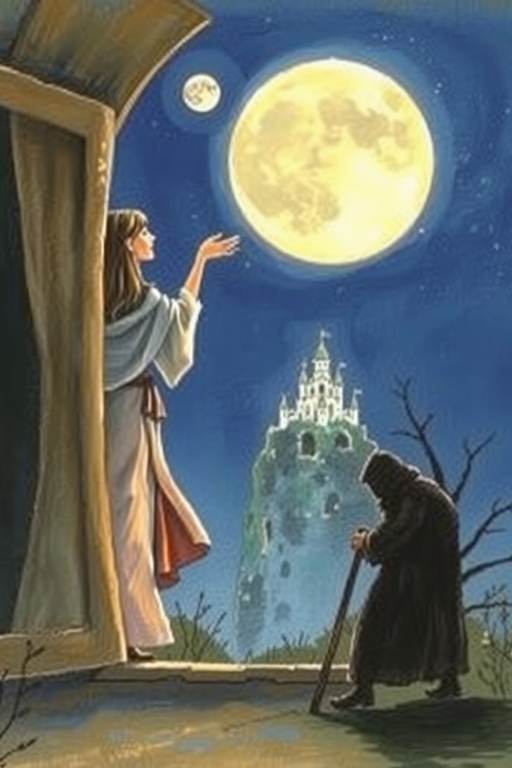
Then the grass turned silver, and the air grew warm as a kitchen. A tall woman made of pale light stood at the top of the hill, her feet not quite touching the ground. Tomas knew her at once from the way the shadows leaned toward her.
“You noticed,” she said. Her voice was low and kind, like a bell heard from far off.
“I noticed,” said Tomas. “Where did it go?”
“It fell,” said the Moon. “Stars are brave, but falling frightens them. It is somewhere near the sea, and it will not rise without a friend. Will you find it?”
Tomas looked at the empty patch of sky. “I’m not very big,” he said.
“You counted it every night,” said the Moon. “It knows your voice.”
***
The village was dark and quiet when Tomas crept down the hill. He knocked on the lamplighter’s door until a lamp flickered in the window. Old Marn opened it wearing a coat over his nightshirt.
“The moon sent me,” said Tomas. “I need a lantern.”
Marn squinted at him for a long moment. Then he laughed, a dry, rattling laugh. “The moon does that,” he said. “Wait there.”
He came back with a spare lantern, dented and brass and smelling of oil. “It holds a light better than it holds a promise,” Marn said. “Keep the wick trimmed. And here.” He tucked a small box of matches into Tomas’s pocket.
“Thank you,” said Tomas.
“Bring it back with a story,” said Marn, and shut the door.
Pim was waiting by the gate, rope trailing. Tomas tied the rope to his belt, lifted the lantern, and looked up. The empty patch of sky lay low and dark above the sea road, the one gap in all that shining.
“Come on,” he told the goat. “We follow the hole.”
The road led downhill between hedges that whispered and rustled. Tomas did not look at them. He kept his eyes on the gap, and the gap kept moving, or seemed to, drifting always a little nearer the sound of waves.
Pim trotted close, and his small hooves went tick, tick, tick on the stones, like a clock that was helping out.
The fog came up from the sea like a tide that had forgotten it was water. It rolled over the cliff path in soft grey waves, swallowing the hedges and the stones and the sky. Tomas held the lantern higher. The flame shrank to a blue bead and guttered, as if it too were afraid of the wet dark.
Pim stopped dead. His rope went taut, and he let out a long, wobbling bleat.
“It’s only fog,” said Tomas, but his own voice sounded small. “Pim. Pim, look at me.”
The goat’s eyes were rolling white. He pulled backwards, hooves skidding on the wet chalk, and the rope burned through Tomas’s fingers. Somewhere below, the sea boomed against the rocks.
Tomas dropped to his knees and put the lantern on the ground between them. “Pim,” he said. “The fog is just the sea’s breath. It’s not a wolf. It’s not a ghost. It’s wet air.”
Pim shuddered and pressed his head against Tomas’s chest. The goat’s heart was going like a drum. Tomas held him and felt the fog beading cold on his neck.
“We’ll go slow,” said Tomas. “One step. Then another. I’ll count them.” He picked up the lantern and stood. “One,” he said, and took a step. The rope went slack, then tight. Pim followed. “Two.” Another step. The flame steadied, a little taller. “Three.”
By the time he reached twenty, the path had begun to slope down, and the fog was thinning. Pim’s hooves ticked behind him, quick and sure. Tomas did not stop counting until he smelled salt and weed and wet sand, and the fog opened like a curtain.
***
The shore lay under a thin grey light, and the sea hissed and pulled at the shingle. Tomas stood at the edge of the beach and looked up. The gap in the sky was directly overhead now, a round dark hole among the stars. It pointed down at the rocks like a finger.
“There,” he whispered. “Pim, look.”
In a rock pool near the tideline, something glowed. It was faint, no brighter than a candle behind a curtain, and it shivered as the waves slopped over the rim of the pool. Tomas climbed down the wet rocks, the lantern swinging, and knelt beside the water.
The star was no bigger than his two hands cupped together. It had six soft points and a pale, milky light that dimmed whenever a wave broke nearby. It was trying to rise, he saw. It lifted a little, wobbled, and sank back.
“Hello,” said Tomas. “I’ve come to take you home.”
The star flickered once, hard, and went dim. It pressed itself into the corner of the pool, against the rock, as far from the open sea as it could get.
“It’s all right,” said Tomas. “I won’t hurt you.”
Another wave slapped the pool’s edge, and the star flinched. Its light guttered almost to nothing.
Pim leaned over the pool and sniffed. The star flared, startled, then softened again.
“It’s frightened of the waves,” said Tomas. “It doesn’t understand they can’t reach it here.” He looked at the little box of matches in his pocket, then at the lantern. “All right,” he said. “We’ll do this gently.”
Tomas set the lantern down at the pool’s edge and opened the little door. The glass inside was warm and dry and still. “Look,” he said softly. “No waves in here.”
The star did not move. It only shivered against its rock.
Pim settled down on the wet stones with his chin near the water and let out a long, low breath. The star’s glow steadied a little at the sound. Tomas thought of the nights on the hill, when he could not sleep and his grandmother would hum until his eyes grew heavy.
“I know a song,” he said. “My grandmother taught it to me. It’s for counting.”
He began, quiet as he could.
“One star, two stars, three stars bright.”
The star lifted its smallest point.
“Four stars, five stars, in the night.”
Pim bumped his nose gently against the pool’s rim, keeping time. The star drifted off the rock and floated, wobbling, toward the lantern’s open door.
“Six stars, seven, eight stars glow.”
It hesitated at the edge of the glass.
“Nine stars, ten stars, all in a row.”
And then it slipped inside, soft as a moth, and settled in the lantern’s heart. The little door clicked shut. Light poured out between Tomas’s fingers, warm and yellow-white, and the whole rock pool turned gold.
“Good,” breathed Tomas. “Good.”
He lifted the lantern. It weighed almost nothing, but it hummed in his hand, the way a cat hums when it is content. Pim scrambled up the rocks ahead of him, and together they started back up the cliff path, one step at a time.
***
The fog had gone thin by the time they reached the top of the hill. Tomas walked with the lantern held high, and the star inside it cast a long, soft shadow of him and Pim across the grass. All night they climbed, and the sea fell away behind them, and the sky above grew paler at its edge.
“Almost there,” Tomas told the lantern. “Look up. That’s where you live.”
The star pressed itself against the glass, bright as a held breath.
At the very top of the hill, where Tomas always counted, the Moon was waiting. It hung low and round and patient, and its light made the frost on the grass shine.
“You found it,” said the Moon. Its voice was like wind in a chimney, but kind.
“It was in a rock pool,” said Tomas. “Frightened of the waves.”
“Then you must let it go where it is not frightened.”
Tomas knelt and opened the lantern door. For a moment the star stayed still. Then it rose, slowly at first, and then faster, trailing a thin line of light. Up it went, past the hill, past the fog, and slotted into the empty patch of sky with a sound like a small bell. The sky was whole again.
“Thank you,” said the Moon.
Tomas looked up at all of them, every star, and found he did not want to count. He simply stood there beside Pim, certain the sky would keep them all safe, and went home to bed.
Written with an AI writing tool and checked automatically before publishing. How we make stories.
 Read next