Story · Slice of life · Ages 8-12
The Lights on Juniper Street
When a power cut leaves Juniper Street dark, Maya and her neighbour Mr. Okafor light lanterns and discover that the whole street has been waiting for an excuse to gather.
Reading settings — text size, spacing, theme and read-aloud mode

Maya had one page of maths left when the lights went out. The fridge stopped humming. The little green clock on the oven vanished. Upstairs, her brother Ben said a word their mum would not have liked.
“Torch,” said Mum, from the hallway. “Drawer by the door. And don’t trip on the buggy.”
Maya found the torch and switched it on. A pale circle jumped across the carpet. It made the sitting room look like a cave she had never seen before.
“Homework,” she said.
“Homework can wait. Go and check on Mr. Okafor. He’s got that bad hip, and his kitchen lights always blow.”
Maya pulled on her coat. Outside, the whole street was dark. No windows glowed. No streetlight buzzed. It was like the houses had all closed their eyes at once.
She walked along the path with the torch beam hopping ahead of her. Mr. Okafor’s gate creaked.
He was already at his door, holding the handle. “Maya? Is that you? Come in, come in. Mind the step.”
“Mum sent me. Are you all right?”
“Fine, fine. I know where everything is in the dark. It’s the rest of the street I’m thinking about.” He shuffled back and let her in. The hallway smelled of toast and old wood.
“Do you want me to sit with you?” Maya asked. “Until the lights come back?”
Mr. Okafor laughed, low and rumbly. “Sit with me? No. I’ve got a better idea. Follow me.”
***
His kitchen was full of lanterns. Maya swung the torch around and counted them twice. There were lanterns hanging from hooks, lanterns on shelves, lanterns stacked in a box by the door. Some were tin, some were glass, and one was shaped like a little house with a red roof.
“Where did they all come from?” she asked.
“Everywhere,” said Mr. Okafor. “Car boot sales, my mother’s attic, a market in the rain. I never could walk past a lantern.”
He lifted one down and set it on the table. “This one’s from the harbour. The fishermen used to hang them on their boats.”
“Do they still work?”
“Some of them. There are candles in the drawer. Now, here is my plan.” He tapped the window, where the dark pressed in. “We put a few on the front wall. Then anyone walking past knows somebody’s home.”
Maya looked at the row of dark windows across the street. “Nobody’s home out there.”
“They’re home,” said Mr. Okafor. “They’re just sitting in the dark, waiting. Go on. Pick three.”
She chose the red-roofed one, a tall tin lantern, and a small round one that looked like a jam jar. Mr. Okafor found matches in a bowl and struck one.
The first flame caught. Then the second. The paper in the tin lantern glowed orange, and Maya felt her face go warm.
“Hold the torch for me,” he said. “I’ll do the reaching.”
They carried the lanterns to the front wall and set them on the wide brick ledge under the window. Three small lights, side by side.
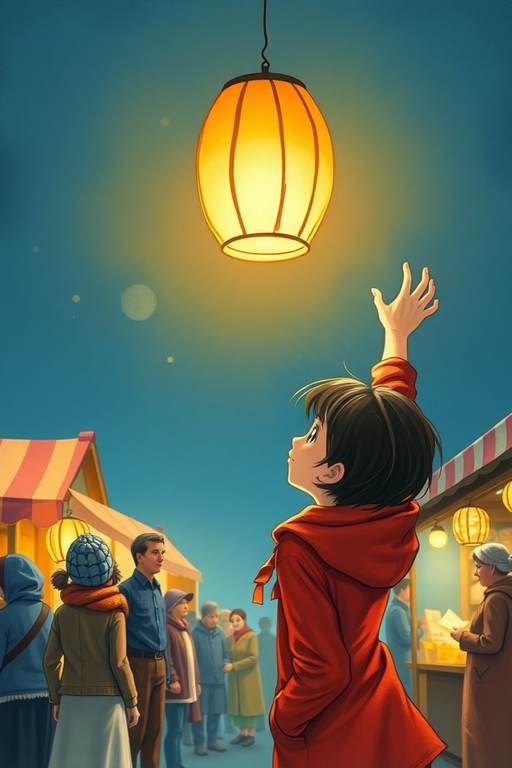
Maya stepped back. The lanterns shone out into the dark street like they were saying hello.
The first person to come out was the woman from number twelve. She stood on her step in a dressing gown, arms folded, staring at the three lanterns.
“Mr. Okafor?” she called. “Is that you?”
“It is,” he said. “And Maya from number four. We’re having a small lighting.”
The woman came closer. Her slippers made a soft sound on the pavement. “I thought it was a fire,” she said. “Then I thought, no, fires don’t line up so neatly.”
“Would you like to light one?” Maya asked.
“I’ve never lit a lantern in my life,” the woman said. But she took the match anyway.
By the time the fourth lantern was glowing, the man from number twenty had arrived with a tin of biscuits. “I heard voices,” he said. “It’s been quiet on this street for years.” He held out the tin. Maya took a biscuit shaped like a flower.
“These are good,” she said.
“My sister makes them,” he said. “She sends me far too many.”
A woman from across the road came over with a flask of tea. Someone else brought a folding chair. Mr. Okafor sat down on it and looked at his neighbours like he was seeing them for the first time.
The street was filling up with people. Not a crowd, exactly, but more than Maya had ever seen out here after dark. A man in a woolly hat. A girl about her age holding a cat. Two brothers who argued about whose torch was brighter.
A boy stood at the edge, hands in his pockets. He looked about ten, with hair that stuck up at the back. Maya waved him over.
“I’m Sam,” he said. “I live at number nine. I’ve never seen everyone out here before.”
“Me neither,” said Maya.
Sam frowned at the little group. “It’s weird,” he said. “We’ve all lived here for ages. But I don’t know anyone’s name. Not really. We just nod and go inside.”
“I know Mr. Okafor’s name,” Maya said.
“You’re the only one,” Sam said. “Everyone else is ‘the lady with the cat’ or ‘the man with the van’.”
Maya looked around. The lady with the cat was talking to the man with the van. The brothers had stopped arguing and were sharing a biscuit.
“My mum says the street used to have a summer party,” Sam said. “Every year. But they stopped when I was little. I don’t know why.”
Mr. Okafor turned in his chair. “I remember the parties,” he said. “There were paper chains across the road. Your mother organised them, Sam.”
Sam’s face went pink. “She never said.”
“People forget,” Mr. Okafor said. “It gets dark, and we go inside, and we forget.”
Maya looked down the street. It ran dark and quiet past the bins and the parked cars, all the way to the corner where the bus stop stood. “Let’s walk,” she said. “To the end and back. With the lanterns.”
Nobody said anything. The man with the van checked his watch. The lady with the cat looked at her front door.
“It’s only ten minutes,” Maya said. “We can’t get lost. It’s our own street.”
Mr. Okafor pushed himself up from his chair. “I’ll go,” he said. “I’ve been at the end of this street a thousand times. But never with a lantern.”
Sam grabbed his lantern at once. “Me too.” Then the brothers looked at each other and shrugged, and one of them picked up the tin with the handle.
“Well,” said the lady with the cat, “I suppose Bella could use a walk.” Bella was the cat. Maya decided not to ask.
The man with the van sighed. “Fine. But I’m locking the van first.”
They set off slowly. The lanterns made small gold circles on the pavement, and the circles moved when the people moved, wobbling and stretching. Sam’s lantern swung as he walked. Mr. Okafor’s lantern was the oldest, with a dent in the top, and it threw the steadiest light of all.
At number nine, Sam’s front door opened. A woman in a dressing gown stood there. “What on earth,” she said.
“We’re walking to the end of the street,” Sam said. “With lanterns.”
His mother looked at the little crowd. Then she went inside and came back with a lantern of her own, and a coat over her arm.
The line grew. At number three, someone shouted down from a window. At number five, a door clicked and a girl in slippers joined the back. By the time they reached the corner, they were eleven people long, and the bus stop stood lit like a little stage.
“Now we walk back,” Maya said.
And they did, slower this time, because people were talking.
***
On the way back, Maya learned that the man with the van was called Dev and he fixed bicycles on Saturdays. The lady with the cat was called Mrs. Patel, and the cat was called Bella, and Bella did not enjoy the walk one bit.
At their own doors, people stopped. But nobody went inside. The lanterns kept burning along the front wall, and the street felt like a room with the lights low.
Then the whole street blinked.
The windows lit up one by one, yellow and white, all the way down. Somebody cheered. Sam’s mother laughed out loud. The lights were back.
“Well,” said Mr. Okafor. “There we are, then.” He sat down in his chair again. He did not get up to go in.
Maya waited. She thought people would say goodnight. She thought the doors would close. Instead, Dev sat on his wall and Mrs. Patel stood by her gate, and the brothers brought out the last of the biscuits.
“We should do this again,” Sam said. “Not the power cut. Just the lanterns.”
“My mother used to say a street is just houses until something happens in it,” Mr. Okafor said.
Maya carried her torch to her own door. She set it on the step, still shining, and left it there. Then she went inside, and her homework was still on the table, waiting.
She did not mind. From her window, she could see the little light by the door. It would burn all night. If the dark came back, someone would see it and know the way to her house.
Written with an AI writing tool and checked automatically before publishing. How we make stories.
 Read next