Story · Myth and legend · Ages 8-12
Each New Star Costs a Memory
In a village where the stars have gone dark, a quiet girl discovers she can weave new ones—but each star costs her a memory of someone she loves.
Reading settings — text size, spacing, theme and read-aloud mode

Nima counted stars the way other children counted sheep. Every clear night she climbed the low flat rock behind her family’s house and named them in order, from the bright one over the well to the small cluster shaped like a spoon.
On the first night of autumn, the spoon was missing a handle. Nima sat up straight.
“You skipped one,” she said to the sky, as if the sky might answer.
It did not. She counted again. Forty-one stars where there had always been forty-four.
By the end of the week the village noticed too. Old Besnik stood in the square with his lantern held high, squinting upward.
“There’s a hole in the sky,” he said. “Right above my roof. I’ve lived under that roof sixty years and there was never a hole.”
“A hole,” said Nima’s mother, pulling her shawl tighter. “Don’t say that in front of the little ones.”
But the little ones had already heard. They stopped playing past dusk. They hurried home when the light went blue, and they kept their shutters closed.
The dark, which had always been friendly, grew heavy. People lit two lamps instead of one. They walked in pairs. Nima heard her father bolt the door at night, though he had never bolted it before.
She went back to the flat rock anyway. The sky was thinner now, like cloth rubbed too long in one spot. Three stars gone, then seven, then twelve.
“Where do you go?” she whispered.
A moth circled her lantern once and drifted off toward the hills. Nima watched it until it vanished, and then she watched the hills, which were dark and patient and much older than she was.
Something was wrong up there. She could feel it the way you feel a loose tooth, with the tip of her mind.
In the morning she asked Besnik about the hills. He was mending a net on his doorstep and did not look up.
“Those hills,” he said, “have kept their own business for a long time. Best let them.”
Nima let them for two more nights. She could not let them for a third.
***
Besnik’s house smelled of smoke and dried mint. Nima sat on a stool by the fire and waited while he poured water into two chipped cups.
“You counted the stars again,” he said.
“Fifteen are gone.”
He nodded slowly, as though he had expected the number. “Then it’s time you heard the story. My grandmother told it to me, and her grandmother told it to her, and I’ve never had cause to say it out loud until now.”
Nima wrapped both hands around her cup.
“Long ago,” Besnik said, “the sky was woven. Every star was a knot in a great cloth, and the one who tied the knots was called the Sky Weaver.”
“A weaver,” Nima repeated.
“She lived in the hills above the village. She had a loom, and on that loom she wove the whole night, star by star. When she finished, she sat back and looked up and was content.”
“What happened to her?”
Besnik poked the fire. “Nobody knows. One evening she climbed the hill and did not come back down. And for a long while the sky held. But cloth wears, child. It frays. Knots slip.”
Nima looked toward the window. Outside, the dark had no stars in it at all, just a low grey nothing.
“So the holes,” she said.
“Are where the knots have come undone.”
“Someone has to tie them again.”
Besnik set down his cup. “The loom is still up there. My grandmother said so. She said it sits in a cave behind the two leaning pines, and it has never stopped waiting.”
“Then I’ll go.”
He did not tell her no. He looked at her for a long moment, and then he reached behind his chair and handed her his lantern.
“The path is steep,” he said. “Go before the moon rises. And Nima — a loom that weaves the sky will ask a price. My grandmother never learned what it was.”
Nima took the lantern. “I’ll learn it,” she said.
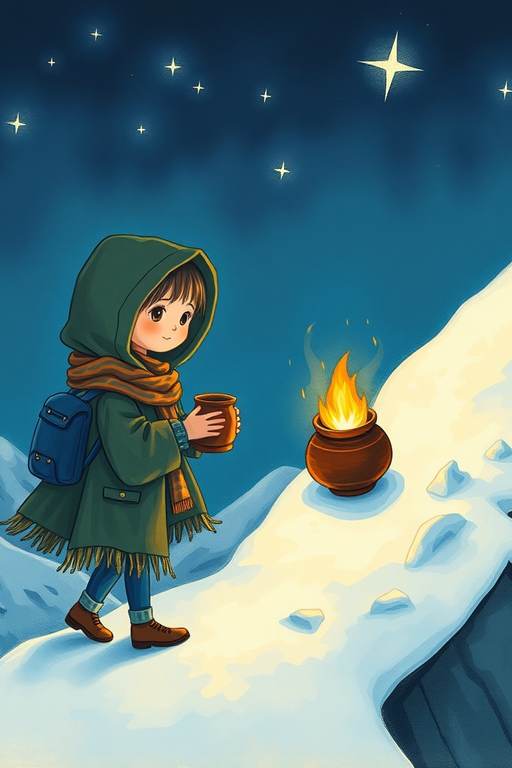
The hill path was steep and loose with stones. Nima held the lantern low and watched her feet. The two leaning pines rose ahead, black against the grey sky. Between them was a crack in the rock, just wide enough for a girl.
She squeezed through. Inside, the cave was dry and warm. A loom stood against the far wall, tall as a door, strung with threads of pale light. Nima lifted the lantern. The threads hummed, very softly.
“You came,” said a voice like paper rustling. An old woman sat on a stool beside the loom. Her hair was white as ash, and her eyes were closed.
“Are you the Sky Weaver?” Nima asked.
“I was. Now I am only the one who waits.” The woman opened her eyes. They were full of tiny stars. “You wish to tie the knots again.”
“Yes. The sky is going dark.”
“Then you must know the price.” The old woman touched a thread. It glowed. “Each star you weave takes a memory from you. A big one. One you love.”
Nima’s hands went cold. “What kind of memory?”
“Something warm. Something you would never choose to lose.” The woman smiled, and it was sad. “I wove a hundred stars. I cannot remember my own name.”
Nima looked at the empty sky beyond the cave mouth. Then she looked at the loom. “Show me how.”
The old woman stood and guided Nima’s fingers to the shuttle. “Think of a memory. Hold it close. Then pull the thread.” She stepped back. “Choose well. You only get to choose once.”
Nima closed her eyes. She thought of her grandmother’s lullaby, the one sung every night before sleep. The tune rose in her, warm and low. She pulled the thread.
The shuttle flew. Light spilled from the loom like water. A single star leapt up through the cave roof and hung in the sky, bright and steady. Nima laughed out loud.
Then she tried to hum the lullaby. Nothing came. Her mouth opened, and where the tune had been there was only a smooth, blank place. She knew she had loved it. She could not remember how it went.
“Grandmother’s song,” she whispered. But the words meant nothing now.
***
The old woman said nothing. Nima stood in the cave with her hands empty. The star she had woven shone through the crack in the rock, small and brave.
“That is the price,” the old woman said at last. “One star, one memory. You paid it.”
Nima wiped her eyes with her sleeve. “I didn’t know it would feel like this.”
“No one does.”
She walked out between the leaning pines. The village lay below, a scatter of roofs and one orange window. People had come out of their houses. They were pointing up. Nima heard a child shout, and then another.
“A star! There’s a star again!”
Besnik met her at the foot of the hill. He carried a second lantern, and his face was worried. “You went up,” he said. “You went up and you came back down. What happened?”
“I wove one,” Nima said.
“And?”
She tried to tell him about the lullaby. The words would not come. “I paid,” she said. “Like you said.”
Besnik was quiet. Then he said, “Your grandmother used to sing that song to you. Every night. Do you remember?”
Nima shook her head. “I know she did. I know it was mine. But I can’t hear it anymore.”
He put his hand on her shoulder. “Then I’ll sing it for you. Badly. Every night, if you want.”
Nima looked up at the one new star. It was not enough. The sky was still mostly grey, and the dark pressed close around the village. But it was one. It was a start.
“Tomorrow,” she said, “I’ll go up again.”
Besnik did not tell her no.
The village woke to music. Someone had found a drum, and someone else a flute, and by noon the square was full of people looking up. The one star hung in the grey like a bead of gold. Children ran between the tables, and the baker brought out a flat loaf shaped like a star.
“We should do this every year,” said Besnik, handing Nima a cup of milk. “A festival for the star that came back.”
Nima drank and said nothing. Her head felt like a room where a chair had been moved. She kept reaching for something and finding the space empty.
The elder came to stand beside her. His name was Duro, and he walked with a stick of blackthorn.
“You went up the hill,” he said. It was not a question.
“I did.”
“And the loom took its price.”
Nima looked at him. “You knew.”
“I knew the story,” Duro said. “The Sky Weaver always paid. That is why there is only one of us at a time.” He tapped his stick on the stones. “My grandmother was the last. She wove forty stars and forgot her own name. We had to tell her what to call herself.”
Nima’s hands went cold. “Forty stars.”
“Forty memories,” Duro said. “She gave them all. And when she died, the sky went dark again, because no one else knew how.”
The festival went on around them. Someone was singing. Nima thought of her grandmother’s lullaby, the one she could no longer hear, and understood that she had traded it for a single point of light.
That night she could not sleep. She climbed the hill again, not to the loom but to the ridge below it, and sat with her back against a stone.
Besnik found her there. He had brought a blanket and wrapped it around her shoulders without asking.
“You’re going to do it again,” he said.
“I have to. One star isn’t enough.”
“Then how many?”
Nima stared at the dark. “I don’t know. As many as I can.”
Besnik sat down beside her. “Then you need a plan. You can’t just give everything away until there’s nothing left of you.”
“The loom takes what it takes.”
“Does it?” He turned to her. “You said you wove one star. Did you choose the memory, or did the loom?”
Nima opened her mouth. Then she closed it. She had not chosen. She had only wanted a star, and the loom had reached in and taken the first thing it found.
“I didn’t choose,” she said slowly.
“Then choose,” Besnik said. “Go up tomorrow and hold on to what matters. Give it the small things. Give it the memory of a rainy afternoon. Give it the taste of a bad turnip. Keep the lullaby, and keep your grandmother’s face, and keep the way you felt when you first saw the loom.”
Nima laughed, once, surprised. “The turnip.”
“The turnip,” he said. “It’s yours to give.”
***
In the morning Nima climbed the hill with her pockets full of stones. She had chosen them the night before, one for each memory she was willing to lose. A stone for the day she fell in the river. A stone for the argument with Besnik about the goat. A stone for the smell of the smokehouse in winter.
At the loom she sat down and set the stones in a row.
“I choose,” she said out loud. “This one. Not that one.”
The loom began to move. Threads of light lifted from the stones, one by one, and spun themselves into the sky. Nima felt each memory go, small and sharp, like a splinter leaving her skin. She did not reach after them.
When she had woven seven stars, she stopped. Her hands were shaking. She still knew her grandmother’s face. She still knew the shape of the lullaby, even if she could not hear the tune. Besnik would sing it to her. She would learn it again.
The sky above the village held eight stars now, and the dark had softened.
Besnik was waiting at the foot of the hill. He did not ask what she had given. He only looked up, and then at her.
“Eight,” he said.
“Eight,” Nima said. “And tomorrow, maybe nine.”
He walked her home. At her door he sang the lullaby, badly, and she listened with her whole body. The tune was not in her, but the kindness was, and that was something the loom could never take.
After that, Nima went up the hill on clear nights. She kept a bowl of small stones by her bed, and she chose each one carefully. The sky filled slowly, star by star, until the village children could count them on their fingers and then on their toes.
Duro called her the Sky Weaver. Nima did not correct him. She only kept her grandmother’s face safe in her mind, and the lullaby safe in Besnik’s voice, and the rest she gave away, one stone at a time.
Written with an AI writing tool and checked automatically before publishing. How we make stories.
 Read next