Story · Myth and legend · Ages 8-12
Ember Carries the Last Coal
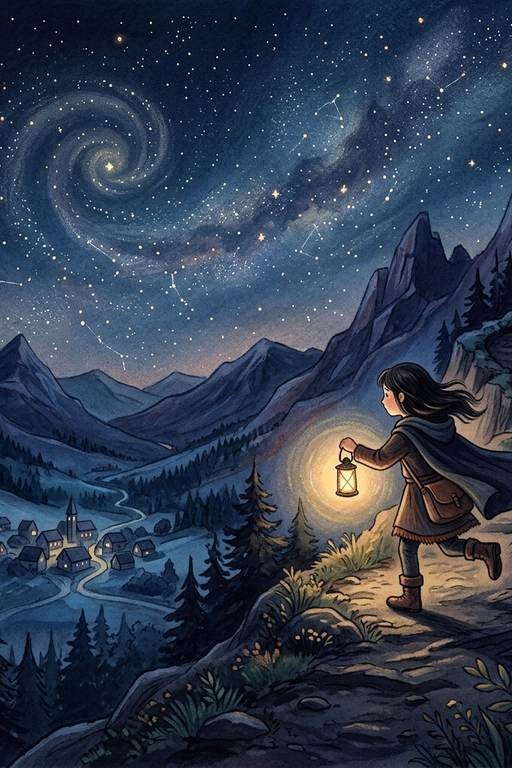
When the fire in the village hearth goes out on the longest night, a girl named Ember must carry a single coal up the mountain to relight it, facing wind, snow, and her own doubt.
Reading settings — text size, spacing, theme and read-aloud mode

The longest night had come, and the village fire had gone out.
It was not a fire that had died by accident. It had been burning for three hundred years, banked each night with oak and ash, fed each dawn by the youngest child. But that evening, the wind came down from the mountain and took the last ember from the hearth.
“The fire is dead,” said Old Rook, the eldest. He held up his hands to the cold. “Nothing here can wake it.”
The villagers gathered in the dark square. Their breath made small clouds. Someone’s baby cried, and someone’s dog whined, and no one had a light to comfort them.
“There is a spark,” said Old Rook, “deep in the mountain’s heart. A fire that never goes out. But the path is long, and the night is bitter.”
“Who will go?” asked a woman near the back.
No one spoke. The wind rattled the shutters. The snow began to fall, slow and steady, covering the roofs in white.
Ember stood at the edge of the crowd, her hands stuffed in her pockets. She was eleven, and small for her age, and she was afraid of the dark. But she was more afraid of a village with no fire at all.
“I’ll go,” she said.
Her voice was quiet, but the square was quieter. Everyone turned.
“You?” said Old Rook. “You’re a child.”
“I’m the one who fed the fire every morning,” Ember said. “I know how it breathes. I know how it wants to be kept.”
Old Rook looked at her for a long moment. Then he nodded, slow. “Then go, fire-keeper. And come back.”
***
Ember’s grandmother lived in a small house at the end of the lane, where the snow had drifted against the door.
She was waiting inside, a shawl around her shoulders and a clay pot in her lap. The pot was round and plain, with a lid that fit snug. She held it out to Ember.
“This was your mother’s,” she said. “She carried it up the mountain once, when she was your age.”
Ember took the pot. It was warm, though no fire had touched it. “Did she find the spark?”
“She found something,” said her grandmother. “Not the same thing you’ll find.”
Ember didn’t ask what she meant. She tucked the pot under her arm and pulled her coat tight. Her boots were old, and the snow was deep, but she had wrapped her feet in wool.
“You’re afraid,” her grandmother said.
“Yes,” Ember said.
“Good. Fear keeps you careful.” Her grandmother kissed her forehead, then whispered in her ear. The words were soft and old, a blessing from a time before the village had a name. Ember didn’t understand them all, but they settled in her chest like a coal.
“Go now,” her grandmother said. “The mountain is waiting.”
Ember stepped out into the night. The snow fell around her, and the wind bit her cheeks, and the dark pressed close. She held the clay pot against her heart and began to climb.
The path up the mountain was a white rope through the dark. Ember followed it, one boot after the other. Wind pushed at her shoulders and tried to turn her around, but she leaned into it and kept climbing. Snow came up past her knees in the deep places. Each step made a soft crunch, like biting sugar.
In the clay pot, the coal glowed faintly. It was the only warm thing for miles. Ember cupped her hand around the little mouth of the pot and blew on the coal. It brightened, then dimmed again. “Stay with me,” she told it. “Just a little longer.”
The coal did not answer, but it did not go out either.
Halfway up, the wind stopped all at once, as if it had run out of breath. Ember looked up. A white fox stood on a rock above her, still as a snowdrift. Its eyes were the colour of winter dawn.
“Hello,” Ember said. Her voice came out small in the wide dark.
The fox did not move. It watched her the way her grandmother watched bread rising, patient and sure.
“Are you lost too?” Ember asked.
The fox turned and stepped down from the rock. It walked a few paces up the path, then stopped and looked back over its shoulder. Its tail curled like a question mark.
“You want me to follow you,” Ember said.
The fox blinked once. That seemed to be a yes.
So Ember followed. The fox’s paws made no sound on the snow, and its fur caught the starlight. Whenever Ember fell behind, it waited. Whenever she stumbled, it looked back until she was steady. The two of them climbed together, girl and fox, up through the frozen pines.
Near the top, the trees thinned out. The wind came back, sharper than before. It came howling down the slope in one long, fierce breath.
The gust hit Ember like a wave. She staggered and threw her arms over the pot to shield it. But the cold was faster than she was. The little coal flared once, bright as a struck match. Then it died. Grey ash puffed out of the pot and blew away into the dark.
Ember stood very still. The mountain was black all around her. The fox had vanished. Her hands were empty of everything but cold.
“No,” she whispered. “No, no.”
She knelt in the snow and felt around with bare fingers. Under the crust, she found a flat stone the size of her palm. Beside it, another, harder and darker, with a good sharp edge. Her grandfather had shown her how to strike sparks from stones. He had done it for fun, on summer evenings, when nobody needed fire for anything.
Ember held her breath. She struck the stones together. Nothing. She struck again, and a tiny orange star leaped off the edge and died in the snow before it landed. Her hands were shaking.
“You are still here,” said a voice behind her.
Ember spun around. The white fox sat in the dark, watching. Its voice was soft and dry, like wind through pine needles.
“You can talk,” Ember said.
“When I need to,” said the fox. “Your coal is gone. Do you go home?”
“No,” Ember said. She struck the stones again, and this time a spark landed on a curl of dry grass and held, tiny and orange, glowing like a seed.
“There,” said the fox. “You carried it after all.”
Ember cupped the spark in the clay pot and breathed on it, gently, the way her grandmother breathed on soup. The spark caught. A small flame stood up in the dark, no bigger than a thumb.
“Come,” said the fox, and walked on up the mountain.
Ember followed, with fire in her hands.
The path grew steep, and the wind lost its bite. Warm air poured down the mountain like breath from an open door. Ember climbed over a lip of rock and stopped.
Before her, a cave opened in the mountain’s side. Light came from it, soft and golden, as if the stone itself were glowing. The white fox sat at the entrance and did not go in.
“This is as far as I go,” the fox said. “The fire inside you is enough now.”
Ember looked down at her clay pot. The flame stood steady, small and bright. “Thank you,” she said. But the fox was already trotting back down the path, a pale shadow against the snow.
Ember walked into the cave. The walls curved like the inside of a bowl. In the center, on a flat stone, burned a fire that gave no smoke. It was warm and endless, and its light filled every corner.
“You are small to come so far,” said a voice. The words came from the fire itself, low and crackling. “What do you want?”
“My village needs a spark,” Ember said. “Our hearth is dead.”
“Many come for fire,” said the guardian. “They carry torches and pots and baskets. The mountain gives flame to those who already carry it within.”
“I do carry it,” Ember said. Her voice shook, but she held up her clay pot. “This is what I have. I made it myself, after the coal went out.”
The fire dimmed, and the cave went dark. Ember could see nothing. Fear rose in her chest, cold and tight.
“Then show me,” said the guardian. “Not the flame in your pot. The fire in you.”
Ember thought of her grandmother’s hands on her shoulders. She thought of the village waiting in the dark, and of the fox who had led her when she wanted to turn back. She thought of every step she had taken, even afraid, even tired.
She spoke into the dark. “I will not give up,” she said.
The cave blazed. Light leaped from the stone, and the guardian’s voice was warm again. “There,” it said. “Take it. You have earned the mountain’s fire.”
Ember dipped her pot into the heart of the flame. The fire rushed in, bright and alive, and she carried it out into the night.
***
The way down was easier. The snow had stopped, and the stars showed through the clouds. Ember held the pot before her, and its light made a small warm circle on the path.
At the bottom of the mountain, the white fox waited. It did not speak. It only looked at her once, then slipped into the trees and was gone.
Ember walked the last mile alone. Her legs ached. Her hands were raw. But the flame in the pot burned steady, and it did not go out.
The village was dark when she reached it. No lamps, no fires, no candles in the windows. People stood in the square, huddled and quiet, their breath white in the cold.
“Ember?” called her grandmother. “Is that you?”
“It’s me,” Ember said. “I brought the fire.”
A murmur ran through the crowd. Ember walked to the great hearth in the center of the square. The stones were cold and black. She knelt and tipped the pot, and the flame poured out like water.
The hearth caught. Fire leaped from log to log, gold and orange, and the square filled with light. People laughed and cried and held out their hands to the warmth.
Her grandmother knelt beside her. “You carried it all this way,” she said.
“It was always mine,” Ember said. “I just had to find it.”
She looked at the faces around the fire. Her home was warm again, and she understood. Home was not the hearth alone. It was the light you carried inside, and shared.
Written with an AI writing tool and checked automatically before publishing. How we make stories.
 Read next