Story · Myth and legend · Ages 8-12
The Star in the Net
A young fisher's net catches a fallen star, and the whole village comes to see it. But when the star begs to go home, only one person listens.
Reading settings — text size, spacing, theme and read-aloud mode

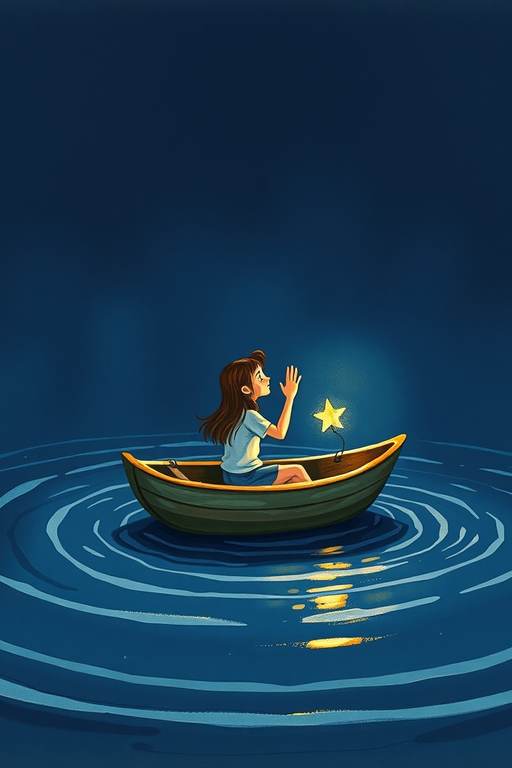
Mara rowed out past the breakwater, where the bay turned from green to black. The village lights shrank behind her, and the only sound was the dip and drip of her oars. She liked it out here. The night smelled of salt and cold, and the stars lay scattered across the water like spilled rice.
Her net was heavy when she pulled it up. Heavier than fish. She hauled it over the gunwale and something inside blazed, so bright she had to shut her eyes. When she opened them, a small star lay tangled in the mesh, pulsing like a heartbeat.
“Easy,” Mara whispered. “I won’t hurt you.”
The star trembled. Its light was the colour of a candle behind a hand, and it made the whole boat glow.
Mara worked the net free, strand by strand. The star was warm, not hot, and it hummed against her fingers like a sleepy bee. She had never touched a star before. Nobody in the village had.
“You fell,” she said. “Didn’t you?”
The star flickered once. Mara took that for yes. She cradled it in the bottom of the boat, on top of her folded coat, and it dimmed a little, as if it trusted her.
***
“I have to go back,” said the star. Its voice was thin and clear, like a bell heard across water. “Before the sky turns grey. If I’m still here at dawn, I’ll go out. Like a match.”
Mara sat very still. The oars rested across her knees. All around them the sea whispered and slapped at the hull.
“Go out?” she said. “You mean forever?”
“Forever,” said the star. “Stars aren’t made for the ground. We’re made for high places and long dark.”
Mara looked up. The sky was crowded with stars, and she wondered which gap belonged to this one. She had never thought of stars as having places before. She had thought of them as one big shining thing.
“How do you get back?” she asked.
“I need to be lifted,” said the star. “High. Higher than the cliffs. From there I can find my way.”
Mara chewed her lip. The cliffs were a long row from here, and the tide was already turning. Her father would be waiting at the cottage door, and he would not be pleased.
“I’ll help you,” she said.
The star brightened. “You promise?”
“I promise,” said Mara. She picked up the oars. The star nestled against her coat and hummed, and the boat turned toward home.
The boat scraped the shingle just before midnight. Mara pulled it up past the tide line and covered the star with her father’s old tarpaulin. It glowed faintly through the cloth, like a coal under ash.
“Stay quiet,” she whispered. “I’ll come back.”
“You promised,” said the star, small under the canvas.
Mara ran up the path with wet boots and salt in her hair. The cottage was dark except for one candle. Her father sat at the table, mending a net, and he looked up when she came in.
“Late,” he said.
“The tide turned,” said Mara. It was true. She hung her coat by the fire and went to bed, and she lay awake listening to the sea.
In the morning the whole village was at the boats. Someone had seen the light through the tarpaulin. Old Bryn, the elder, stood at the front with his stick.
“Bring it out,” he said.
Mara’s father lifted the canvas. The star lay in the bottom of the boat, dim now in the daylight, but everyone gasped. Children pressed close and grown-ups murmured. Bryn tapped the hull with his stick.
“A treasure,” he said. “A wonder for the village. We’ll keep it safe in the meeting house.”
“It doesn’t belong in a chest,” said Mara.
“It belongs where it can be seen,” said Bryn. “By all of us.”
The men carried the star up the hill. It flickered when they lifted it, and Mara felt her promise pull tight in her chest like a knot.
***
They put the star in the old iron chest in the meeting house, the one with the brass latch. Bryn turned the key and hung it on a nail by the door.
“Tomorrow we’ll show it to the village,” he said. “Everyone will come.”
Mara watched through the window as they left. The star glowed faintly inside the chest, a thin line of light along the lid. She pressed her palm to the glass.
That night she waited until her father’s breathing went slow and even. Then she pulled on her boots and crept out. The moon was thin, and the path to the meeting house was grey and quiet. The door creaked when she pushed it. Inside, the chest sat alone on the platform, humming.
“Mara?” said the star.
“I’m here.” She lifted the key off the nail. Her hands were shaking, and the brass was cold. The latch clicked open.
Light spilled out across the floorboards. The star was smaller than before, and its edges had gone soft and dim.
“You came,” it said.
“I promised.” She scooped it up in her coat. “We have to hurry. The sky’s already turning.”
She ran down the hill with the star against her chest. The boat was where she had left it, and the tide was high and black and ready. Mara pushed off, and the oars bit the water, and the village fell away behind her, and the star began to hum.
The first wave hit the boat sideways. Mara grabbed the gunwale and held on. Water poured over the bow and sloshed cold around her ankles.
“Mara!” the star cried. Its light guttered like a candle in a doorway.
“I’m here!” she shouted. Rain stung her face. The oars twisted in her grip, and one tore loose and floated away.
“Turn back,” the star said. “You can still make the shore. Please.”
Mara looked over her shoulder. The village lights were small and orange, blinking far across the black water. Home. Warm. Safe.
Then she looked at the star. Its glow was fading, and a thin grey edge crept across it like frost.
“If I turn back, what happens to you?”
“I go out,” the star said quietly. “Not tonight. But before morning. There’s no sky here to hold me.”
The wind screamed. Another wave lifted the boat, and Mara’s stomach dropped. She thought of her father’s slow breathing, of the chest locked in the meeting house, of the elder’s hands closing over the lid.
They had kept the star to keep it safe. But keeping it was killing it.
“Which way?” Mara shouted. “Tell me which way!”
The star pulsed once. A thin beam of light shot from its middle, straight across the water, toward the deepest part of the bay. Mara grabbed the one oar she had left and dug it into the sea.
“That’s it,” the star said. “Follow it. Don’t stop.”
“I won’t.”
The boat climbed a wave and crashed down. Mara’s arms burned. Salt stung her eyes. The beam wavered, but it did not go out.
“You’re doing it,” the star whispered. “You’re doing it, Mara.”
She rowed. The storm threw everything it had at her, and she rowed.
***
The storm broke just before dawn. The clouds split open, and the sea went quiet and silver. Mara’s boat bumped against the tall rock at the mouth of the bay.
She climbed out with the star in her coat. Its light was so faint now she could barely see it. Her legs shook, and her hands were raw, but she climbed.
At the top, the sky was turning pink and grey. The star lay in her palms like a small warm coal.
“This is the highest place,” she said. “Is it high enough?”
“Yes,” the star said. “This is right.”
Mara held it up. “Will you come back?”
“Every night,” the star said. “Look up.”
She opened her hands. For a moment the star rested there, glowing faintly, and then it rose. Up it went, slow at first, then faster, leaving a thin gold line across the sky. It climbed past the clouds and kept going until it was a bright point among all the other bright points.
Mara laughed out loud, alone on the rock, soaked and shivering.
When she rowed back, the whole village stood on the beach. Her father ran into the water to reach her.
“Mara!” He pulled her out of the boat. “We thought the sea took you.”
“I had to bring it home,” she said.
The elder stepped forward. “The star is gone, then.”
“No,” said Mara. She pointed up. There, in the paling sky, one star still burned, bright and steady, long after all the others had faded.
Everyone looked. Nobody spoke.
“It’s ours,” Mara said. “But it isn’t ours to keep. It’s ours to see.”
The elder nodded slowly. That night, the whole village came out to the shore to watch it rise. Mara stood with her father, and the star blinked once, just for her.
Written with an AI writing tool and checked automatically before publishing. How we make stories.
 Read next