Retold classic · Folk tale · Ages 8-12
The Girl Who Fed the Gate
A retelling of The Baba Yaga
A widower's new wife sends his daughter to a hungry aunt in the forest. The girl survives by giving the birch, the gate, the dogs, and the cat exactly what they want.
Reading settings — text size, spacing, theme and read-aloud mode

The stepmother came in from the yard with her shawl still on. “Varya,” she said, “take this basket to my sister in the far woods. She’s poorly and wants company.”
Varya knew the far woods. Everyone did. You did not go past the black birches after dark. “Which sister?” she asked, and her voice came out smaller than she wanted.
“The one who lives alone. You’ll know the house. It stands on stilts.” The stepmother pushed the basket into her hands. “Go now, before the light goes.”
Varya’s real aunt, old Marta, was at the gate before she reached it. Marta sold honey at the market and knew every road in the county. “Where are you off to with that basket?” she asked.
“To the stepmother’s sister. In the far woods.”
Marta took the basket and set it on the ground. “That woman has no sister who keeps a house,” she said quietly. “She has a sister who eats people. The Baba Yaga. And she has been waiting a long time for a girl to come walking up her path.”
Varya’s hands went cold. “Then I won’t go.”
“You must go,” said Marta. “If you run home now, your stepmother will find another errand, and another, until one of them works. But listen to me, and you may come back.”
***
Marta opened her own gate and led Varya into the yard. From a chest by the door she took four small things: a red ribbon, a little clay pot of oil, a heel of bread, and a strip of bacon wrapped in a leaf.
“The birch tree in her yard will whip you as you pass,” Marta said, tying the ribbon around Varya’s wrist. “Tie this to its branch. It only wants to be pretty.”
She pressed the pot into Varya’s palm. “The gate has hinges that have never been oiled. Grease them, and it will swing quiet and let you through.”
“And these?” Varya asked, holding up the bread and the bacon.
The old woman smiled. “The dogs by the gate will bark and snap. Give them the bread. There’s a cat in the house, thin as a rake. That bacon is for the cat, and don’t forget it, whatever else happens.”
“What about the woman herself?”
“She’ll set you to weaving and tell you to heat the bath,” said Marta. “Do as you’re told, but slowly. There’s a servant girl there who fears her more than she fears you. A kind word and a small gift will turn her.”
Varya put everything in her pockets. “Why are you helping me?”
“Because someone once helped me,” said Marta. “Now go, and keep your eyes open. The world is full of things that only want a little kindness.”
The forest went quiet the way a room goes quiet when someone is listening. Varya walked until the trees leaned close and the path turned to needles and moss. Then the birch tree stood in front of her, pale as a candle, and it bent its branches down across the path like arms.
“You’re not going through,” the birch whispered, leaves shivering.
Varya stopped. She remembered Marta’s voice. She took the ribbon from her wrist and held it up. “This is for you. It only wants to be pretty.”
The birch went still. Then a branch dipped, gentle as a hand, and Varya tied the red ribbon around it. The tree straightened, and the path opened.
At the fence, the gate hung crooked on its hinges, and it groaned when she touched it. Varya found the little pot of oil and worked it into the iron, hinge by hinge, until the gate swung without a sound. It sighed and let her by.
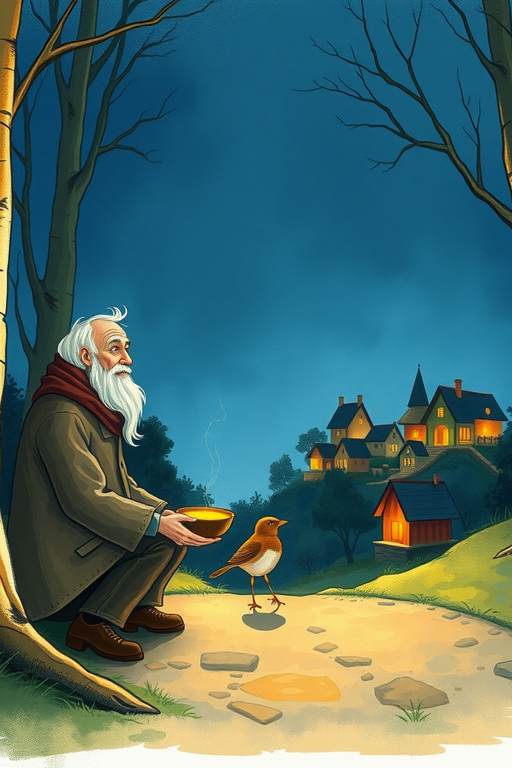
Two dogs lay in the yard, thin and watchful. They rose, and their growls started low. Varya crouched down and broke the bread into pieces. “Here,” she said. “I brought this for you.” The dogs ate, and their tails moved, and they let her pass without a sound.
The house stood at the end of the yard, dark and leaning. In the doorway sat a cat, thin as a rake, with green eyes and a crooked ear.
“You smell of the forest,” said the cat.
“I brought you something,” said Varya, and held out the bacon. The cat ate it slowly, and then it looked at her a long time.
***
Inside, the house was warm and smelled of smoke and old wood. A great loom stood in the corner, and the woman at the window was taller than any woman should be. Her teeth were long, and her eyes were bright as glass.
“So,” said the Baba Yaga. “My sister’s stepdaughter. Sit at the loom and weave, and be quick about it. And heat the bath, for I’ll want it after.”
Varya sat at the loom. Her hands found the threads, but she moved them slowly, the way Marta had told her. In the other room, a servant girl knelt by the stove, feeding it wood, and her face was tired and her hands were red.
“Is the bath hot?” the Baba Yaga called.
“Not yet,” said Varya, and she kept weaving slow.
When the old woman had gone out to the yard, Varya crossed to the servant and took the handkerchief from her pocket. It was white, with a small blue flower stitched in the corner.
“This is for you,” she said. “I only want to know the way out of the yard.”
The servant girl looked at the handkerchief, then at Varya. “She’ll eat me too if she finds I helped you,” she whispered.
“Then don’t help me,” said Varya. “Just tell me where the path begins.”
The girl tucked the handkerchief into her sleeve. She said nothing, but her eyes went to the back door and stayed there, and that was answer enough.
Varya went back to the loom, and the threads moved slow under her hands, and the fire under the bath crept higher.
The fire under the bath ticked and settled. Varya’s shuttle went back and forth, and the shadows in the hut grew long and leaned toward her. Then something soft pressed against her ankle.
It was the cat. It sat down on the floor and looked up at her with yellow eyes.
“You gave me bacon,” the cat said. “Nobody gives me bacon.”
“You were hungry,” said Varya.
“This is a house where everyone is hungry,” said the cat. “And nobody shares. So listen. The old woman is out in the yard counting her firewood. When she comes back, she will not come back alone.”
Varya’s hands stopped on the loom. “What do you mean?”
“I mean run,” said the cat. It pushed something across the floor with its paw. A small towel, folded thin. And beside it, a comb with three teeth, worn smooth as river stones. “Take these. When she is close, throw the towel behind you. When she is closer, throw the comb. Do not look back to see if it worked. Just run.”
Varya took the towel and the comb. “Why help me?” she asked.
“Because you noticed me,” said the cat. “Most people don’t.”
It walked to the back door and sat beside it, tail flicking. Varya slipped out. Behind her she heard the door of the yard bang, and the old woman’s voice, low and pleased, saying, “Now. Now.”
Varya ran.
***
The birch tree let her pass without a word. The gate swung open at her touch, its hinges quiet, and the dogs only watched her with their heads tipped, bread still in their teeth. Then the wood began to shake.
“Varya!” called the Baba Yaga, and her voice was not angry. It was sweet, and that was worse. “Come back, little one. You forgot your supper.”
Varya threw the towel over her shoulder.
Behind her the ground went soft. Water came up out of it, wide and grey, and spread through the trees until the path was gone. She heard the old woman stop and stamp. She heard her mutter. Then she heard her begin to wade.
Varya ran on, her breath short, twigs catching at her sleeves. The wading got louder. The voice got nearer, humming now, humming as if she had all night.
So Varya threw the comb.
The wood behind her grew thick. Trees came up fast as spring grass, trunks pressing to trunks, branches lacing overhead. The water vanished under roots. Somewhere back there the old woman shouted once, and then the shouting was only wind.
Varya climbed the last hill with her heart banging. Down in the hollow she saw her own chimney, thin smoke going up, and her father’s shape in the doorway.
“Varya?” he said, when she came into the light. “What happened to you?”
She told him. All of it. The errand, the aunt’s small gifts, the birch and the gate, the dogs and the cat, the loom, the bath, the towel, the comb.
Her father listened with his hand over his mouth. Then he went inside and spoke to his wife, and his voice was quiet and steady, and it did not stop for a long time.
In the morning the stepmother put on her coat and went out the door and did not come back.
The house was quiet after that. Quiet in a way it had never been, with room in it for two people to sit.
Varya kept the comb’s three teeth in her pocket, and sometimes she turned them over. She found she looked at things now. The kettle, the hinge, the cat on the step. She knew what each one wanted.
It was not a bad thing to know.
Written with an AI writing tool and checked automatically before publishing. How we make stories.
Where this story comes from
- Retold from
- William Ralston Shedden Ralston, "The Baba Yaga"
- Author
- William Ralston Shedden Ralston (d. 1889)
- First published
- 1872
- Edition used
- Project Gutenberg ebook 22373 — Russian Fairy Tales: A Choice Collection of Muscovite Folk-lore (New York: Hurst & Co., 1872); plot reference only; retold from the story
- Public domain because
- translator died 1889; the fetched edition is 1872 — clear in the US, EU and Indonesia
- Checked
- 2026-10-27
- Notes
- Ralston's volume is a scholarly collection with comparative footnotes; those are research, not text. The 1872 Hurst edition is the one fetched, which is why the entry records 1872 where the older row in the sourcing list said 1873.
This is a retelling in new words, not a copy of the original text. See sources for every classic on the site.
 Read next