The Weather Ledger · Part 1 · Everyday magic · Ages 8-12
The First Line
Otis keeps the weather ledger for his grandfather, but one night a line appears in a hand that isn't his. A quiet, bright story about a boy, a hill, and a patient answer.
Reading settings — text size, spacing, theme and read-aloud mode

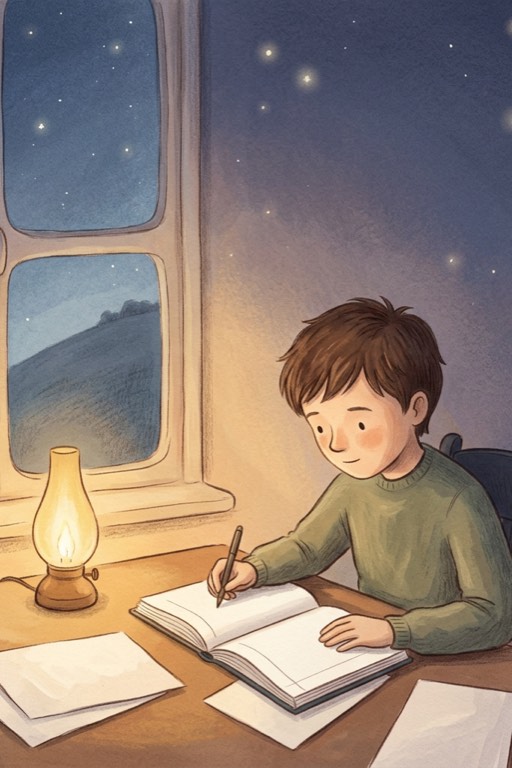
Otis wrote the weather in the ledger every night at the same time, after the dishes and before bed. The book lived on the sill by the window, thick as a loaf, its spine cracked like a knuckle. He opened it at the last page and uncapped his pen.
“Wind from the west, turning north by dark,” he said out loud, because his grandfather had always said it out loud. “Rain after midnight.”
He wrote it down in his small, square hand. 12th of March. Wind W-N. Rain after midnight. Then he sat back and looked at the hill. No lights on it. No sound but the phone box humming at the bottom of the lane.
His pen was still in his hand when he saw it. Below his line, in a hand he did not know, someone had written: And frost before morning.
Otis put the pen down very slowly, as if it might go off. The ink was dry. The letters leaned left, old-fashioned, looped like ribbon. He checked the page before. His own entry for yesterday. Nothing else.
“Right,” he said, which meant nothing was right at all.
He looked out at the hill. The sky was clear, but it had been clear all week and last night there had been no frost. He touched the strange line with one finger. Then he closed the ledger, blew out the lamp, and lay awake listening to the window for a long time.
***
Mira arrived at half past eight with the post and her bicycle leaned against the wall. She wore her coat done up wrong and her hair full of wind.
“You look like you’ve seen a ghost,” she said, handing him a brown envelope.
“There’s a line in the ledger,” Otis said. “Not mine.”
She followed him inside and read it twice. “It’s a joke. Someone got in and wrote it.”
“The door was locked. Grandfather’s room is right there.”
“So you wrote it and forgot.”
“I don’t forget a whole sentence.”
Mira folded her arms. “Then it’s a trick, and I don’t believe in tricks until I’ve seen one. Let’s test it.”
They took the ledger to the kitchen table and copied the strange line onto a scrap of paper. Then they went round the village. Seven houses. At each door Mira held up the scrap and asked if the writing looked familiar. Mrs. Parry said no. The man at the chapel said his eyes were bad. The phone box had no one in it.
At the last house, the old shepherd looked at the paper for a long time. “That’s not from anyone here,” he said. “That’s older than anyone here.”
Mira took the paper back. Her face had gone still. “Right,” she said, using Otis’s word without noticing. “So it’s a trick nobody wrote.”
Otis looked at the hill through the kitchen window. The sky had clouded over, grey and low, and a thin white rime was starting to show on the wall.
***
That night Otis sat at the window with the ledger open on his knees. Rain tapped the glass. He had thought about what to ask all through tea, and he had decided to be careful. Questions were like eggs. You held them too tight and they broke.
He dipped the pen and wrote under the strange line, in his best handwriting: Who is writing in this book?
Nothing happened. Wind came off the hill and shouldered the house. He watched the page until his eyes ached. Then he wrote the weather, because that was the rule: Rain, heavy, from the west. Rime on the wall.
He turned the page to check the ink was dry, and there it was, under his own line, in the old formal hand.
Someone who has been here longer than the book.
Otis sat very still. “That’s not an answer,” he said out loud, to the room, to the window, to whatever it was.
The rain kept on. He read the sentence again. It was true, he supposed. It just wasn’t useful.
In the morning he took the ledger to Mira’s shed, where she kept the post bicycle and a kettle.
“Longer than the book,” she said, reading it twice. “The book’s a hundred years old. What’s longer than a hundred years?”
“The hill,” said Otis.
“The hill doesn’t write.” She poured the tea. “Ask it something with a yes or no in it. Then we’ll know if it’s guessing.”
Otis thought about that all day, and by evening he knew what to ask.
***
He waited until the house was quiet. Grandfather’s lamp went off at nine. The kettle ticked as it cooled. Otis sat by the window with his back to the wall, so that he could see the page and the hill at once.
He wrote: Will it snow before Sunday?
Then he blew out the lamp and sat in the dark, because if anything was going to write, he wanted to see it happen. The moon was behind cloud. The window was a grey square. He counted his own breaths and lost count twice.
At some point the house settled, the way houses do, and his chin touched his chest, and he woke with a jerk to find the sky pale and the rooks awake and the page turned.
Under his question, in the old hand: Yes.
Otis looked out. The wall was white. The hill was white. Snow lay on the seven roofs of Highside like a held breath. It had come in the night, without wind, the way snow comes when the sky is deciding something.
He had not seen anyone write. He had watched, and then he had slept, and the answer had arrived anyway. It did not need him to watch. That was the part that stayed with him, going down the stairs to put the kettle on. It had never needed him to watch.
***
Grandfather was awake when Otis carried the tea in. Not properly awake — his eyes were open and fixed on the ceiling, which was how Otis knew to sit down and wait.
“Snow,” Grandfather said.
“Yes,” said Otis. “All night. No wind.”
“Bram,” said Grandfather, which was his own name, so Otis waited.
A hand came up off the blanket, thin as a twig, and pointed at the window without quite reaching it. “Your grandmother used to say the hill wrote to her,” Grandfather said. “I told her hills don’t write. She said, no, but they answer.”
Otis put the cup on the side table. “Answer how?”
“In the book.” Grandfather’s eyes slid to the door, and past the door, and down the stairs, to the front room where the ledger sat. “She’d write a question. Never got an answer straight off. She said it had to be a question worth the ink.”
“Did you ever see who wrote back?”
“I never asked it anything,” Grandfather said, and his voice was so ordinary about it that Otis almost missed the shame in it. “I wrote the weather down. That’s all I did. A hundred years of weather and not one question.”
Then he was asleep again, or nearly, his mouth moving around a word Otis couldn’t catch.
Otis sat with him a while. The tea went cold. Outside the window the snow held its shape, and every roof in Highside wore a white cap, and the hill went up and up to where the sky began.
“Right,” Otis said, quietly, to nobody.
***
That evening Otis opened the ledger and dipped the pen and did the thing he had been avoiding all day. He wrote the weather first, because that came first. Wind: none. Rain: none. Frost: hard. Snow: four inches, settled.
Then he turned to a fresh line and wrote, in his own plain hand: I don’t know who you are. I’ll keep writing anyway.
He did not ask a question. He had decided on the stairs that a question was a kind of demand, and he was not ready to demand anything from something that had waited a hundred years.
He closed the book. He put the pen down beside the lamp. The house was quiet in the way snow makes a house quiet, which is not really quiet at all — it is the sound of everything being held.
Otis looked out at the hill. The snow on it had gone blue with evening. The sky above was the colour of a hand held over a candle. He thought about Grandfather saying she said it had to be a question worth the ink. He thought about Mira saying prove it. He thought about the word Yes sitting in the ledger under his own question, patient as a stone in a river.
Something was out there. Not watching him. Not waiting for him to sleep, or to look, or to believe. Just there, the way the hill was there, the way the sky was there, enormous and unhurried, and willing to write back.
Otis turned the lamp down until the flame went out. The room went dark except for the snow-light coming through the window, which was enough to see the shape of the ledger on the table, and enough to see the hill.
He went up to bed. Tomorrow he would write the weather again, and the day after that, and that was the whole of it — one line an evening, and a question when he had one worth the ink.
Outside, the hill stayed where it had always been. It did not need him to watch it. But he was glad, all the same, that it was there.
Written with an AI writing tool and checked automatically before publishing. How we make stories.
 Part 2