Story · Spooky · Ages 8-12
The Bell That Rang Backwards
When a strange bell begins ringing backward at midnight, a girl must find the courage to face what it calls out of the dark.
Reading settings — text size, spacing, theme and read-aloud mode

Tess was not supposed to be awake at midnight. She lay on her bed with the window open a crack, listening to the town breathe. Somewhere a dog barked twice and gave up. The gutter dripped. Then the church bell spoke.
It did not say bong. It said gnob. Tess sat up so fast her quilt slid to the floor. The bell in the tower had rung the hour backward for as long as she could remember hearing about it, which was never. Old Mr. Pettigrew wound the clock every Sunday and the bell struck clean and low. Tonight it struck wrong.
Bong, it went, then gnob, then bong again, like a word spoken into a jar.
Tess pressed her nose to the cold glass. The moon was a thin white shaving over the roof of the church. In the tower window, high up where the bell hung, something moved.
It was not a bird. Birds do not stand still and tall and lean against the stone. The figure had shoulders. It had no face she could see, only a smudge of darker dark.
“Hello?” Tess whispered. The window was shut and the figure could not hear her. Still, it turned, as if it had.
The bell rang backward once more, soft, and then the tower went quiet and the figure was gone.
Tess pulled the quilt up to her chin and did not sleep for a long time. In the morning the bell rang nine perfect times for nine o’clock, and Mr. Pettigrew polished the brass and hummed, and nobody said a word about midnight.
At breakfast her mother asked why she looked so tired. Tess said she had heard an owl. It was the first lie she had told in a month, and it sat in her stomach like a cold pebble.
***
Ben was waiting at the gate with his bike on its side and a sandwich in his hand. “You look like you saw the church fall down,” he said.
“Worse,” said Tess. She sat on the wall and told him everything, the backward bell and the tall dark shape in the tower window. Ben chewed and listened, which was one of the good things about him.
“Backward?” he said at last. “Bells don’t do that.”
“This one did.”
Ben brushed crumbs off his knees. “Could be the wind in the rope.”
“The wind doesn’t have shoulders.”
He was quiet for a moment. Then he grinned, the way he did before trouble, and Tess felt her heart speed up because she had known he would.
“We go tonight,” Ben said. “After everyone’s asleep. We climb up and look.”
Tess looked at the tower. It was a good tower, grey and square, with a door she had walked past a thousand times without once thinking of opening. Now it seemed taller.
“What if it’s still up there?” she said.
“Then we’ll see it properly,” said Ben, “instead of squinting out a window. Bring a torch. And wear shoes you can run in.”
“I’m not running,” said Tess. Her voice came out firmer than she felt, and she liked the sound of it. “I want to know what it wants.”
Ben held out half his sandwich. She took it. They shook on it the way they always did, sticky fingers and all, and the bell above them stayed silent and ordinary in the daylight.
The church door was unlocked, which Tess hadn’t expected. Ben pushed it open an inch at a time, and the hinges complained in a low, sleepy voice. Inside, the dark smelled of old wood and colder stone.
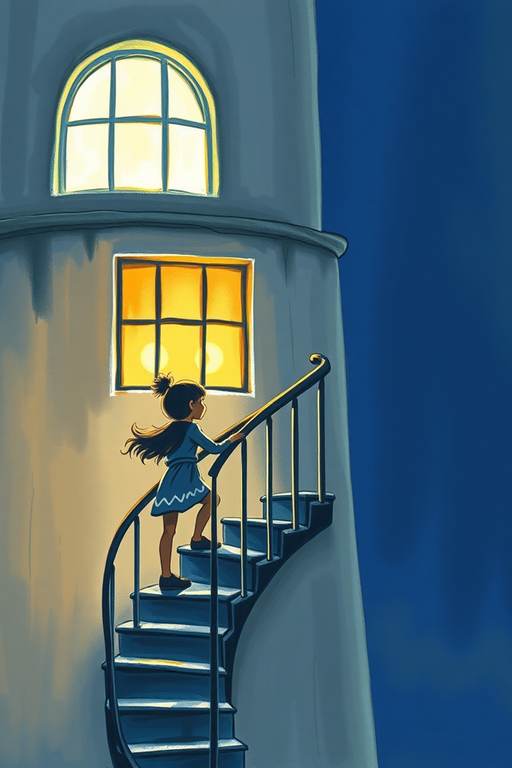
Their torches made two small moons on the wall. Ben went first up the spiral stairs, one hand on the rope rail. Tess counted the steps under her breath to keep her mind off the draught that kept finding her neck.
“Forty-one,” she whispered. “Forty-two.”
“Stop counting,” Ben hissed back. “It makes it worse.”
At the top, the stairs opened into the bell room. The great bell hung in its wooden frame, dark and enormous, its lip wide as a dinner table. Moonlight fell through the louvres in long grey stripes.
And the rope was moving.
It swung gently, back and forth, with nobody holding it. Tess stared until her eyes hurt. The rope lifted, then dropped, lifted and dropped, like someone pulling it who wasn’t quite strong enough.
“Ben,” she said. “Ben, look.”
He was already looking. His torch beam shook. “Tell me that’s a draught.”
“It’s not a draught.”
The air turned cold, sudden as stepping into a cellar. It pressed against Tess’s face and made her ears hum. She could see her own breath. Something was in the room with them, patient and waiting, and it wanted the rope.
***
Tess did not run. She stood very still and listened, the way she did when her little brother was hiding somewhere in the house. You didn’t find him by shouting. You found him by paying attention.
The rope pulled again. One pull, then a pause, then another. Not ringing the bell. Just touching it, gently, like a hand resting on a door.
“It’s not trying to scare us,” she said slowly.
“It’s doing a good job anyway,” said Ben.
“No, listen. It’s the same pattern. One pull, wait, one pull.” Tess took a step closer. The cold moved with her, or she moved with it, she couldn’t tell. “It’s like when you knock and nobody answers, so you knock again, in case they didn’t hear.”
Ben lowered his torch. “Knocking on what?”
“On the bell. On the sound.” The idea came to her all at once, clear as a struck match. “The bell rang backward last night. Backward is how you call someone. That’s what the old rhyme says. You ring it backward to call the lost home.”
“Tess, that’s a rhyme for children.”
“Then why is it here?” Her voice came out steady. “Someone rang it wrong. On purpose or by accident. And now something’s come, and it’s trying to answer, and it can’t.”
The rope swayed. The cold leaned close, and Tess felt it, a small lonely ache, like standing outside a lit window in the rain. She knew that feeling. Everyone did.
“It’s lost,” she said. “It heard the call and it came, but the bell stopped, and now it doesn’t know the way.”
Ben was quiet a long moment. Then he lifted his torch and held it steady on the rope. “So what do we do?”
Tess looked at the great bell, and then at the rope, waiting in the cold. “We ring it forward,” she said. “We finish what someone started.”
Tess took the rope in both hands. It felt like holding a length of winter. “Stand by the door,” she said. “If it goes wrong, you run for help.”
“It won’t go wrong,” Ben said, and stayed exactly where he was, torch up, eyes bright.
She pulled. The rope came down heavy and slow, and high above them the great bell moved. One swing. The clapper struck and the sound rolled out over the town, round and plain and honest, the way a bell is supposed to sound. Dust sifted from the beams. Somewhere below, a window rattled in its frame.
“Again!” Ben shouted.
Tess pulled a second time. Bong. The cold in the tower loosened, like a held breath let go. On the third pull the bell sang out and the whole room seemed to warm by a degree, and the shadow by the window was no longer a shadow.
It was a boy about her age, in an old-fashioned coat with a collar turned up. He looked tired and relieved, the way people look at the end of a long walk. He did not frighten her at all.
“You rang it right,” he said. His voice was quiet, like wind through a keyhole. “I heard it backward and I came, but then it stopped, and I couldn’t find the door.”
“You’re home now,” Tess said. She didn’t know how she knew it, but the words came out sure and warm.
The boy smiled. “Thank you,” he said, and the tower lightened, and he was gone, and only the smell of old wood and rain stayed behind.
***
The bell rope hung still. Ben lowered his torch and let out a breath he had been holding since the first pull. “Did you see him?” he whispered.
“I saw him,” Tess said. Her hands were shaking, but not from fear. It was the good kind of shaking, the kind you get after you jump from a wall and land on your feet.
The two of them sat on the top step with their backs against the wall and watched the sky go grey through the narrow windows. The town below was still asleep. Soon the baker would light the ovens, and the first bus would cough its way up the hill, and nobody would know.
“We should tell someone,” Ben said.
“Who would believe us?” Tess wound the rope neatly around its peg, the way she had seen the old bell-ringers do it on festival days. “Anyway, it’s done. He’s not lost anymore.”
They climbed down in the dark, counting the steps. At the bottom, the church door let in a thin grey stripe of morning. Tess stopped and put her hand flat on the cool stone of the wall, where a hundred years of hands had rested before hers.
The bell did not ring again that night. But on Sunday, when the ringer pulled the rope for the morning service, the sound came out round and clear over the rooftops, and Tess heard it from her garden and smiled.
She walked to school the long way now, past the tower, and looked up. It had been there her whole life and she had never once looked up. Scary things, she decided, were mostly just things that had lost their way. She was not afraid of the dark bell anymore. She knew its voice.
Written with an AI writing tool and checked automatically before publishing. How we make stories.
 Read next