Story · Slice of life · Ages 8-12
The Night the Streetlights Learned Our Names
When the streetlights on Juniper Street start flickering out one by one, eleven-year-old Sam and his neighbor Mrs. Alvarez must find out why before their whole block goes dark.
Reading settings — text size, spacing, theme and read-aloud mode

Sam was doing his homework at the kitchen table when the light outside the window went strange. It buzzed, blinked twice, and dimmed to a dull orange, like a coin left in a pocket. Then it popped off altogether.
“Mom,” he called. “The streetlight just died.”
His mother didn’t look up from the dishes. “It’ll come back on. They always do.”
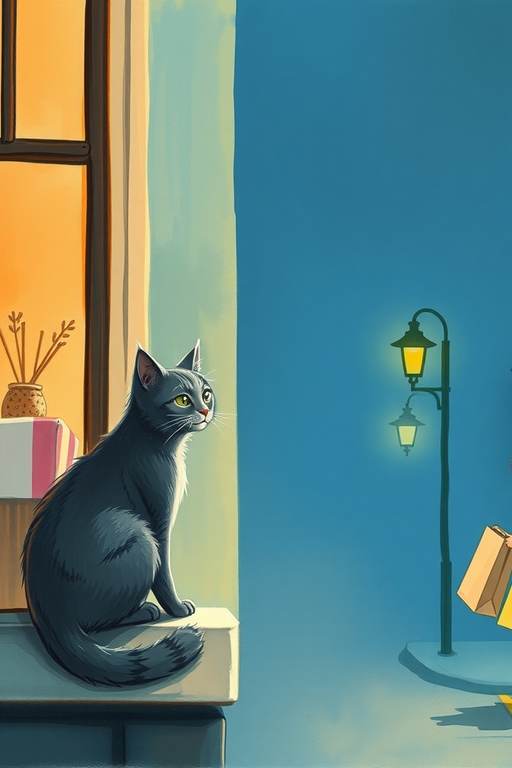
Sam pressed his nose to the glass. The pole stood at the corner of his yard, tall and thin, with a little glass head that had always glowed gold over the sidewalk. Now it was just a dark shape against a darker sky. The whole block seemed quieter without it.
He pulled on his sneakers and slipped outside. The evening air smelled like cut grass and somebody’s grill. Across the street, Mrs. Alvarez was on her porch, watering a row of geraniums in old tin cans.
“Evening, Sam,” she said. “You’re out late.”
“The light went out.” He pointed up at it. “Right while I was watching.”
Mrs. Alvarez set down her watering can. She was old and small, with silver hair pinned up and a cardigan the color of oatmeal. But her eyes were sharp as buttons.
“Third one this week,” she said.
“Third?” Sam frowned. “I only saw this one.”
“The one by the bakery went Tuesday. The one near the corner of Ash on Thursday.” She wiped her hands on her cardigan. “I keep a list. I’ve lived on this street forty years, and I know when the lights misbehave.”
Sam looked down the block. It was true — the far corner looked dimmer than it should. A little prickle ran up his arms, the good kind, the kind that came before a mystery.
“Do you think something’s wrong with them?” he asked.
Mrs. Alvarez picked up her watering can again. “Something’s wrong with something,” she said. “Question is what.”
***
In the morning, Sam found Mrs. Alvarez on the sidewalk with a notebook and a pencil stub. She wore a straw hat against the sun.
“You’re coming,” she said. It wasn’t a question.
They walked the block together, slow as beetles. At each pole, Mrs. Alvarez stopped and squinted up. Sam wrote in the notebook: pole, number, on or off. His handwriting was messy, but she didn’t seem to mind.
“Off,” she said at the bakery corner. Sam wrote it down.
They passed the blue house where the twins lived and a dog barked at them through the fence. The pole there glowed steady and gold, even in the daylight.
“On,” Sam said, and wrote it.
By the time they reached the far end of the block, he had six marks and a question. “Mrs. Alvarez, why are some on and some off? It’s not every other one. It’s not one side of the street.”
She took the notebook from him and turned it around. “Look again,” she said. “Look at what’s behind each one.”
Sam looked. The bakery pole was dark, and the bakery was shut. The blue house pole was lit, and through the window he could see the twins’ mother folding laundry in a bright kitchen. The Ash Street corner was dark, and its house wore drawn curtains and no car in the drive.
“The lights that stay on,” he said slowly, “are the ones where somebody’s awake.”
Mrs. Alvarez smiled. “Now you’re seeing it.”
Sam turned the notebook over and started a new list, a list of windows.
Sam walked home with the notebook open in his hands. At every pole he stopped and counted windows. “Two lit here,” he said. “One there. That one’s all dark.” Mrs. Alvarez followed with her hands in her coat pockets, nodding at each count.
At the corner of Maple, a lamp burned steady as a candle. Behind it, a man sat at a table with a lamp of his own, hunched over papers. “Working late,” Sam said. “Writing it down.”
The bakery pole was still dark. So was the pole by the empty house with the drawn curtains. Sam chewed the end of his pencil. “It’s like the light needs somebody to keep it company,” he said. “Like it gets lonely.”
“Maybe,” said Mrs. Alvarez. “Or maybe it’s simpler than that. Maybe the lights just like to know somebody’s home.” She looked up at her own porch light, small and yellow against the dusk. “Mine’s on,” she said. “I’m usually up till eleven.”
Sam stopped at his own gate. The streetlight above it was still burning, pale and patient. “Mine’s on,” he said. “Because I’m out here looking at it.”
“Or because your dad’s inside with the kitchen radio going,” she said.
Sam looked in through the window. His dad was at the sink, sleeves rolled up, singing badly to a song Sam could not hear. The kitchen light was bright enough to spill onto the grass. “He’s awake,” Sam said. “So mine stays on.”
“So it seems,” said Mrs. Alvarez. She tapped the notebook. “You’ve got your list. What are you going to do with it?”
Sam looked up at the pole. The light hummed quietly, a small steady sound, like a cat purring somewhere above his head. “I’m going to keep it on,” he said. “All night.”
***
That night Sam did not go to bed. He sat on the porch step with a blanket around his shoulders and watched the lamp. It burned white and even, and every time it flickered he sat up straighter and said, “I’m here. I’m here.”
At nine his dad came out. “Bed,” he said.
“I’m keeping the light on,” Sam said.
His dad looked up at the pole and then down at Sam, and his face went soft. “All right,” he said. “Half an hour. Then bed.”
At half past nine Sam’s eyes felt full of sand. He counted the cracks in the sidewalk. He counted to a hundred twice. The lamp hummed above him, patient and steady, and the night got quieter and quieter.
He woke in his bed with his shoes still on and sunlight in the curtains. For a moment he did not remember. Then he was up and at the window, and his heart dropped like a stone in a well.
The streetlight above his gate hung dark and silent. No hum. No glow. Just a gray pole and a gray little head against a gray morning sky.
His dad was in the kitchen, pouring cereal. “You fell asleep on the step,” he said. “I carried you in. You’re getting heavy.”
“The light went out,” Sam said.
“Lights do that.”
“No.” Sam pressed his forehead to the cold window. “It went out because I fell asleep. Because nobody was awake.”
His dad set down the cereal box. “Sam,” he said, “it’s a streetlight.”
“I know,” Sam said. And he did not know how to say the rest — that the light had been keeping him company, and he had not been able to keep it company back. He took the notebook from the table and wrote one word under the dark pole.
Off.
That afternoon Sam sat on his front step with the notebook open on his knees. Mrs. Alvarez came down her walk with a watering can and stopped at his gate.
“You look like a boy doing hard sums,” she said.
“I’m trying to figure out how to keep a light awake,” Sam said. “But I can’t stay up every night. And the light goes out when nobody’s up.”
Mrs. Alvarez set the watering can down. “Then maybe one person staying up isn’t the answer,” she said. “Maybe the whole street needs to be awake together.”
Sam looked up. “All at once?”
“Why not?” She smiled. “We could have an evening on the green. Bring a chair, bring a story. I’ll make cocoa in a big pot.”
Sam thought about the dark poles up and down the block. “Do you think people will come?”
“Leave a note in every mailbox,” Mrs. Alvarez said. “Say the lights are lonely. That’ll get their attention.”
So they wrote the notes that evening. Sam drew a little streetlight at the top of each one, with a face and two round eyes. Mrs. Alvarez wrote the words: Come sit under the dark poles Friday at dusk. Bring a story and a mug.
On Friday, Sam carried folding chairs to the green with his dad. The sky went pink, then purple. One by one, people came. Mr. Okafor from the corner brought a blanket. The twins from number twelve brought a bag of cookies. Even the man who never waved, Mr. Pike, came and stood at the edge with his hands in his pockets.
“I didn’t think anyone would come,” Sam said.
Mrs. Alvarez poured cocoa. “People come when you ask them,” she said. “That’s the whole trick.”
***
They sat in a loose circle on the green. Above them, every pole on the block stood dark and quiet.
“Who has a story?” Mrs. Alvarez asked.
Mr. Okafor told one about a dog who learned to ride a bicycle. The twins told one about a cat who could count to ten but only backwards. Sam told one about a streetlight that woke up when someone laughed. People chuckled. Someone passed the cookies around.
Then Mrs. Alvarez told a story about her grandmother’s kitchen, and how the whole family would squeeze in to listen to the radio. “The little light over the stove was always on,” she said. “It made the room feel full.”
For a while nobody spoke. The air was soft and blue. Then a hum started, low and steady, from the pole at the corner.
Sam sat up straight. “Did you hear that?”
The light above Mr. Okafor’s head flickered once, twice, and came on. Warm gold spilled down over the circle. Everyone turned to look.
“Well,” said Mr. Okafor. “I’ll be.”
Another hum, closer. The pole by the twins’ house blinked and glowed. Then the next one, and the next, like a row of candles being lit. Sam’s own streetlight woke last, right above his gate, and it seemed to him it shone a little brighter than before.
Mrs. Alvarez raised her mug. “To company,” she said.
“To company,” everyone answered.
Sam looked around the circle at all the faces lit up gold, and he understood something he couldn’t quite put into words. The lights didn’t need someone to stay awake and worry. They needed people to be together, talking and laughing, so the street felt full.
The next Friday, Sam set out the chairs again. He propped a sign on his gate: Porch Night, every Friday, bring a story. Mrs. Alvarez brought cocoa. The lights hummed above them, and Sam smiled, because now he knew how to keep them on.
Written with an AI writing tool and checked automatically before publishing. How we make stories.
 Read next