Story · Funny · Ages 8-12
The Goat Who Ate the Mayor's Speech
When a hungry goat swallows the mayor's big speech the night before the town's birthday, two kids must help her remember it before the whole celebration falls flat.
Reading settings — text size, spacing, theme and read-aloud mode

Juno the goat had a talent for doors. Not opening them politely. Not knocking. Just finding the one door in town that somebody had forgotten to latch, and walking through it as if she owned the place.
On the morning before the town’s hundredth birthday, that door belonged to the town hall. It stood open while a man carried in folding chairs. Juno slipped past his legs, quiet as a sneeze.
Upstairs, the mayor’s office smelled of coffee and lemon polish. On the big desk lay a blue folder, and on the folder lay a speech. Forty years of mayoring had gone into that speech. Every word was typed, tidy, and ready.
Juno had never learned to read. She had, however, learned to chew.
The paper tasted faintly of glue and very much of lunch. Juno began at the top, worked down the middle, and finished with a corner that said, Friends, neighbours, and honoured guests. Then she sat back on her haunches and looked pleased with herself.
A clock ticked. A fly buzzed. Juno ate a stray daisy off the carpet and wandered out again, leaving only a paper corner and one small hoofprint on the mayor’s chair.
***
Mayor Pettigrew opened her office door at nine o’clock sharp, carrying two cups of tea. She set them down. She looked at the desk. She looked again.
“Where,” she said, very quietly, “is my speech?”
The blue folder lay open like an empty mouth. Scraps of paper were scattered across the carpet. One small hoofprint sat on her chair, neat as a stamp.
“No,” said the mayor. “No, no, no. The hundredth birthday is tomorrow. The whole town is coming. The band is coming. The cake is coming.”
She picked up a scrap. It said: …and it is with great pl— The rest was gone.
Down in the hall, two children heard the shouting. Ada and Sam were there to hang a banner that said ONE HUNDRED YEARS, and Sam was standing on a chair because he was not tall enough to reach the hook.
“That’s the mayor,” said Ada.
“That’s the mayor shouting,” said Sam.
They found her on her knees, gathering crumbs of paper. Ada looked at the hoofprint. Sam looked at the daisy on the carpet.
“I think we know who did this,” said Ada.
“It’s always who you think,” said Sam.
Mayor Pettigrew stared at them. “You know who ate my speech?”
“Juno,” said Ada. “She’s a goat. She lives behind the bakery. She eats everything.”
“Then find her,” said the mayor, “and get my words back!”
Ada and Sam looked at each other. Sam climbed down off the chair.
“We’ll fix it,” said Ada. “We promise.”
“Somehow,” added Sam, under his breath.
***
Juno was exactly where she always was, behind the bakery, standing in a pile of yesterday’s bread. She looked up with flour on her nose and a daisy hanging out of her mouth.
“There she is,” said Ada. “The criminal.”
“The very full criminal,” said Sam. “Look at that belly.”
Juno’s belly was round as a drum. Ada put her hands on her hips. “Okay. New plan. We make her burp it up.”
“How do you make a goat burp?” asked Sam.
“I don’t know. You pat them?” Ada patted Juno’s side. Nothing happened.
Sam tried patting a little harder. Juno hiccuped. It was a tiny, polite hiccup. A single daisy petal floated out of her mouth and landed on Sam’s shoe.
“That’s not a speech,” said Sam.
“Try again,” said Ada. She patted. Sam patted. Juno hiccuped again, and out came one more petal. Then she burped for real, a soft, grassy burp, and a whole mouthful of daisies fell out onto the ground.
“She’s eating flowers now,” said Sam. “She’s not even sorry.”
Juno chewed. She looked at them with her sleepy, golden eyes. Then she swallowed and licked her lips.
“Maybe we need to shake her,” said Ada.
“We are not shaking the goat,” said Sam. “Remember what happened at the harvest fair?”
Ada remembered. Nobody had been able to find the mayor’s hat for three days.
“Okay,” said Ada. “No shaking. But we have to do something.” She looked at Juno’s mouth. “Say something, Juno. Say ‘welcome.’”
Juno said nothing. She just hiccuped one last time and wandered off toward the flower boxes outside the post office.
“That’s it?” said Sam. “One hiccup and some daisies?”
“She’s not a machine,” said Ada. “She’s a goat.”
***
They followed Juno down the high street. The goat walked like she had all the time in the world. She stopped at every patch of clover and nibbled it down to the roots.
“Maybe it’s still in there,” said Ada. “The words. Maybe they’ll come out if she eats enough.”
“That’s not how goats work,” said Sam.
“Do you have a better idea?”
Sam did not. So they followed. Past the post office, past the bakery with its warm bread smell, past the bench where old Mr. Fennel fed the pigeons.
“Good morning, Juno,” said Mr. Fennel.
Juno bleated. It was a long, wavery bleat that sounded a bit like “good morning” if you squinted with your ears.
“She said it back!” said Ada.
“She said nothing,” said Sam. “She’s a goat.”
But Ada was already crouching in front of Juno, holding out a handful of clover. “Say ‘welcome,’ Juno. Come on. Welcome.”
Juno ate the clover. Then she looked at Ada and let out a bleat that went up at the end, like a question.
“That’s not welcome,” said Sam.
“It’s close,” said Ada.
They tried again by the fountain. Sam held a dandelion and said, “Say ‘friends.’ Say ‘hundred years.’ Say anything.”
Juno sneezed on the dandelion. The seeds flew everywhere. Then she bleated, a short, flat sound, and went back to eating.
“She’s not going to say it,” said Sam. “She’s just going to eat the whole town.”
Ada sat down on the fountain edge. The water splashed behind her. Juno wandered over and put her head on Ada’s knee. Her horns were warm from the sun.
“She doesn’t know she ate anything important,” said Ada. “She just knows it tasted like paper.”
“Paper with words on it,” said Sam. “The mayor’s words.”
Juno looked up at them and bleated again. This time it was soft, almost gentle. Ada scratched behind her ears.
“We should get to the celebration,” she said. “Maybe something will happen.”
“Something always happens,” said Sam. “That’s the problem.”
***
The town green was packed by afternoon. Bunting hung between the lampposts, red and yellow and blue. A brass band played something that was almost a tune. Ada and Sam stood near the front, where the steps led up to the podium.
Mayor Pettigrew climbed the steps with her folder tucked under one arm. She wore her good coat with the shiny buttons.
“Friends!” she called out. “Neighbours! Welcome to our hundredth birthday!”
The crowd clapped. The mayor smiled, opened the folder, and looked inside.
Her smile slid off her face like water off a window. She turned the folder over. She looked in the pocket of her coat. She looked at the sky, as if the speech might be up there, floating.
“Are you all right, Mayor?” called a woman near the back.
“Yes!” said the mayor. “Fine! Wonderful! I had a speech. It was here. It was very good.”
A long, quiet pause stretched out over the green. Somebody’s dog barked.
Then there was a clatter on the steps.
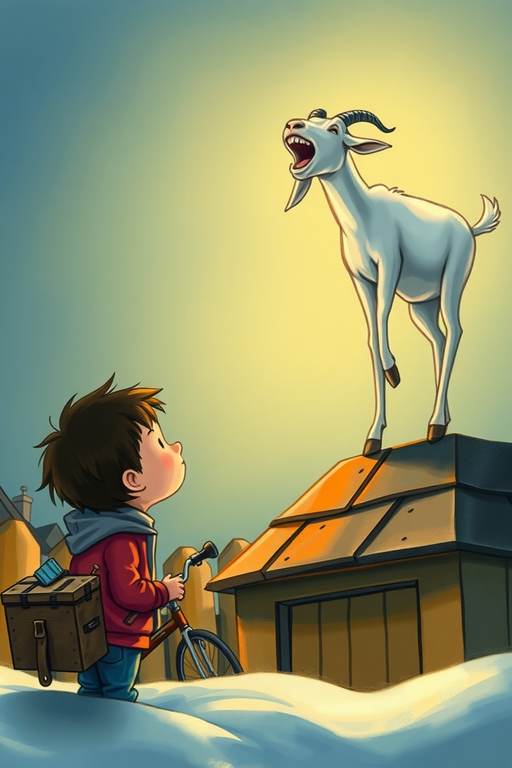
Juno had come up the side of the stage, hooves clicking on the boards. She walked past the mayor like she owned the place. At the podium she stopped, raised her chin, and looked out at the crowd.
“Go on, then,” whispered Sam.
Juno opened her mouth. What came out was the longest bleat anyone had ever heard. It started low and rolled along like a drum. It climbed and wobbled. It dipped and rose again, and it had a little pause in the middle, exactly where a person would stop to breathe.
The crowd went silent.
Then a man in the front row laughed. A woman next to him laughed too. Soon the whole green was laughing, and clapping, and someone whistled.
“That,” said Ada, “was the opening line.”
***
Mayor Pettigrew looked at Juno. Juno looked back, calm as anything, with a bit of bunting thread on her chin.
“Well,” said the mayor. “I suppose that’s one way to give a speech.”
The crowd laughed again. The mayor held up her hand, and the green went quiet.
“Friends and neighbours,” she said, “I had a speech written down. Every word of it was perfect. But a goat ate it, and now I’ll have to say it properly.”
She took a breath. “A hundred years ago, this town was four houses and a well. Now look at us. We have a bakery that never sleeps, a band that almost plays in tune, and a goat who eats important papers.”
Everybody cheered. Somebody’s dog barked again, and this time it sounded happy.
“So let’s not have a perfect speech,” said the mayor. “Let’s have a good day instead.”
Ada and Sam looked at each other. Sam’s mouth was open. Ada’s was too.
After the cheering, the mayor came down the steps. She stopped in front of the two of them and folded her arms.
“You two promised to get my words back,” she said.
Ada’s cheeks went red. “We tried. We really did. But she wouldn’t give them up.”
“She only hiccuped,” said Sam. “And some daisies.”
The mayor looked at Juno, who was now nibbling the corner of the ONE HUNDRED YEARS banner.
“Then I’ll keep her,” said the mayor. “Somebody has to eat the paper I don’t need. And somebody has to remind me not to write such long speeches.”
Juno bleated, once, short and flat. It might have been thank you. It might have been lunch.
Ada scratched the goat’s warm head. “She’s not very good at words,” she said.
“No,” said the mayor, smiling. “But she’s very good at doors.”
That evening, Ada walked home past the town hall. The door was shut tight, and for once, Juno was nowhere near it. Ada smiled and kept walking.
Written with an AI writing tool and checked automatically before publishing. How we make stories.
 Read next