The Lantern Keepers · Part 1 · Family · Ages 8-12
The First Night
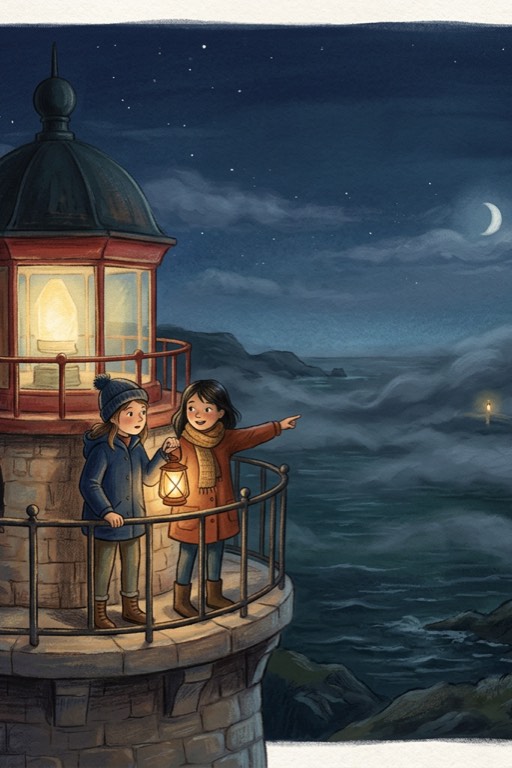
Nell and Tessa must keep the harbour light burning through a storm while their father is away. A story of courage, sisters, and the long dark hours before dawn.
Reading settings — text size, spacing, theme and read-aloud mode

Nobody had to tell Nell it was time. The harbour light went on at the same hour every evening in winter, and she could feel the hour in her hands before the clock said it.
She climbed the tower stairs with the box of matches in her fist. Fourteen steps to the first turn, then twenty more, then the little iron ladder up into the lamp room. The glass was cold against her cheek.
“Don’t drop the matches,” Tessa called from below.
“I never drop the matches.”
“You dropped the matches in October.”
“That was one match,” Nell said. “And it was raining on the stairs.”
She lifted the glass door and struck a match. The flame caught the wick with a small yellow shrug, and the light began to turn, slow and patient, out across the water. Nell watched it go the way she always did. It was the only thing in Garrow that never hurried.
Below, Tessa stood at the window with her elbows on the sill. The last boat was coming in, the Marianne, low in the water with a night’s catch. Nell counted the men on the deck. Three. That was right.
Their father came up the stairs two at a time, pulling on his coat. “The Marianne’s engine is running rough,” he said. “I’m going down to the pier. Tessa, you’re in charge. Nell, you keep the light.”
“We know,” said Tessa.
He looked at them both for a moment, the way he did when he wanted to say more than he was going to. Then he was gone, and the door banged, and the lamp turned, and the dark came in properly behind the boat.
***
The wind got up around nine. Nell heard it first as a rattle in the vent above the stove, then as a low sound in the chimney, like somebody breathing in the next room.
She was doing her tally in the notebook. Boats in: four. Boats out: two. Wind: rising. She wrote it down because writing it down made it smaller.
Then she smelled it. A thin, sharp smell, like a candle that has been left too long.
“Tessa.”
“Mm.”
“The lamp’s smoking.”
Tessa came over and looked up through the glass. A grey thread was curling off the wick and drifting against the lens. “That’s not good,” she said.
“I know it’s not good.” Nell was already at the drawer under the chart table, the one where her father kept the spare wicks, rolled in paper and tied with string. She pulled it open.
Empty. A pencil, a bit of chalk, a brass key that fitted nothing she knew. No wicks.
The wind pushed at the tower and the light flickered once, then steadied, then flickered again.
“Where are they?” Nell said, more to herself than to Tessa.
“He must have moved them.” Tessa was already pulling on her boots. “I’ll run for Mr Caddy.”
“No.” Nell shut the drawer. “We can do it.”
“Nell, the light’s going out.”
“It isn’t going out. It’s smoking. That’s different.” Nell took her penknife off the shelf and put it in her pocket. “The wick just needs trimming.”
Tessa stared at her. “You’ve never done that.”
“I’ve watched him do it a hundred times.”
“Watching isn’t doing.”
The wind came again, harder, and a fleck of soot landed on the glass like a moth. Below them the sea was all noise and no shape.
“I’m going for Mr Caddy,” Tessa said.
“Tessa.”
But Tessa was already going down the stairs, two at a time, and the lamp was still smoking, and the drawer was still empty, and Nell was alone with the light.
Tessa was back in the lamp room before Nell had moved. “I’m going for Mr Caddy,” she said. “He’s got a key to the store. He’ll know about the wicks.”
“Tessa, it’s half a mile to his house. And the wind’s getting worse.”
“Then I’ll run.” Tessa pulled her coat off the hook. “You stay and watch the light.”
“No.” Nell took her penknife out and opened the blade. “The wick just needs trimming. I’ve seen Dad do it.”
“Seen isn’t done.” Tessa’s voice went sharp. “You’re eleven. You can’t climb that ladder in the dark.”
“I can.” Nell’s heart was going like a bird in a box, but her hands were steady. “If you go, you’ll be gone twenty minutes. The smoke will ruin the glass by then. And the light could go out.”
“Then let it.” Tessa stopped, and her face changed. “I didn’t mean that.”
“I know.” Nell put the knife in her pocket. “But we can’t just wait. One of us has to do something.”
“And that’s you?”
“It has to be.” Nell looked at the smoking lamp, then back at her sister. “You can help by staying.”
Tessa stood still for a moment. The wind rattled the glass, and the light flickered again, weaker now. “Fine,” she said, but her voice was tight. “Do it your way.” She turned and went down the stairs, her boots loud on the stone, and the door at the bottom banged shut.
Nell was alone. The lamp hissed and smoked. She took a breath, then climbed the iron ladder to the lamp platform, her penknife cold in her hand.
***
The ladder was steep and the rungs were slick with damp. Nell went up slowly, one hand over the other, until her head was level with the burner. The flame was yellow and ragged, and soot had already begun to cloud the glass. She could feel the heat on her face.
She set her penknife on the platform and reached for the little brass handle that turned the wick down. It was hot. She pulled her sleeve over her fingers and turned it anyway. The flame sank, then guttered, and for a second the room went almost dark.
“Don’t,” she said out loud. “Don’t go out.”
She took the knife and slid the blade under the charred top of the wick. It crumbled away, black and flaky, and she scraped until fresh white wick showed underneath. The smoke thinned. She turned the handle back up, a little at a time, and the flame caught and grew steady and gold.
But her hand slipped. The hot metal of the burner touched her fingers, and she jerked back with a small cry. Two fingers were red and sore. She put them in her mouth, then wiped them on her jumper.
The light was burning clean now. The glass was still smudged with soot, but the beam reached out over the harbour, and the sea answered with a long grey line of foam. Nell sat on the platform and held her smarting hand. Below her, the tower was quiet. Somewhere down in the dark, Tessa was running.
She stayed there, watching the flame, until the pain faded to a dull throb. Then she climbed down, one-handed, and went to find the cloth to clean the glass.
The stairs shook under her. Tessa came up two at a time, out of breath, rain in her hair, with a wooden box under her arm. She thumped it on the table.
“Wicks,” she said. “From the boathouse. Dad keeps a spare box behind the paint tins. I remembered.”
Nell looked at her. “You went all the way to the boathouse?”
“You said fix it ourselves.” Tessa pulled off her wet coat and dropped it on a chair. “So I did.”
The box was damp at the corners. Nell lifted the lid. Inside, wrapped in greaseproof paper, were six new wicks, each one white and clean and neat.
“They’re the right size,” Nell said. She held one up against the lamp. “Exactly right.”
“Course they are.” Tessa came to stand beside her. “What do I do?”
Nell showed her how the wick sat in its holder, and how the little wheel lifted it. Her burned fingers were clumsy. Tessa took the wheel and turned it, slow and careful, while Nell guided the new wick into place with the tip of her knife. The paper rustled. The wick slid home. Tessa wound the wheel until a clean white edge showed above the burner.
“Now light it,” Nell said.
Tessa struck a match. Her hand was steady. The flame caught, blue at first, then yellow, then a strong gold light that filled the glass and pushed the dark back off the water. The beam swept out over the harbour, past the pier, out to where the sea and the sky were the same grey.
“It’s brighter,” Tessa said.
“It’s clean.” Nell wiped the glass with the cloth she’d fetched, and the light came through without a smudge. “That’s why it was smoking. The old wick was burnt down to nothing.”
They stood together and watched it burn.
***
The wind dropped as the night went on. By midnight the rain had stopped and the tower was quiet except for the soft hiss of the lamp. Nell made tea and they sat at the table in the lamp room, the light turning slowly above them.
“You ran all the way to the boathouse in the dark,” Nell said.
Tessa shrugged. “It wasn’t far.”
“It’s half a mile.”
“I know how far it is.” Tessa wrapped her hands around her mug. “I didn’t want to go to Mr Caddy. He’d have made a fuss and sent someone and it would have taken all night.”
Nell nodded. “You were right about that.”
“I know.” Tessa smiled into her tea. “You were right about the wick, though. I’d have run for help. You fixed it.”
“We fixed it,” Nell said.
They sat without talking for a while. The lamp turned. Out on the water a single light showed where a boat was heading in, slow and steady, and then it was gone behind the pier.
Nell’s fingers still hurt. She held them against the warm mug and watched her sister’s face in the lamplight. Tessa looked tired and pleased with herself, and younger than thirteen.
“I’m glad you came back,” Nell said.
“I was always coming back.” Tessa got up and fetched the blanket from the cot in the corner. She put it round Nell’s shoulders, then sat down again. “Go to sleep if you want. I’ll watch the light.”
“You’ll wake me if it goes wrong?”
“It won’t go wrong.” Tessa pulled her chair closer. “But yes.”
Nell put her head down on her arms. The table was cool. The lamp hissed and turned, and the light went out over the harbour, and out over the sea, and the sea gave it back in small bright pieces. She closed her eyes.
When she woke, the window was grey with dawn. Her father was standing in the doorway, still in his coat, smelling of engine oil and salt.
He looked at the lamp. Then at his two daughters, one asleep at the table and one awake, watching him.
“Engine’s fixed,” he said quietly.
“So’s the light,” said Tessa.
He nodded once. He hung his coat on the hook and put the kettle on, and none of them said anything more. Outside, the sun came up over Garrow, and the lamp went out on its own, the way it always did.
Written with an AI writing tool and checked automatically before publishing. How we make stories.
 Part 2